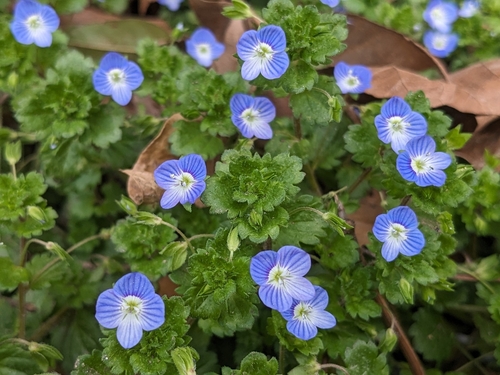
bird's-eye speedwell
Veronica persica
A tiny jewel of the early spring, the bird's-eye speedwell paints lawns and garden edges with brilliant splashes of sky-blue. This resilient traveler is one of the first sources of nectar for waking bees, opening its delicate 'eyes' only for the brightest sunshine.
Quick Identification
Size
A low-growing, creeping plant with stems 10–40 cm (4–16 in) long; individual flowers measure 8–12 mm (0.3–0.5 in) in diameter.
Colors
Brilliant sky-blue petals with darker blue veins and a distinct white center (the 'eye'); the lowermost petal is often smaller and paler or completely white.
Key Features
- Bright blue four-petaled flowers with a white center
- Flowers grow on long, slender stalks from the leaf axils
- Hairy, heart-shaped or oval leaves with coarsely toothed edges
- Creeping, prostrate growth habit that forms dense mats
When You’ll See Them
Geographic range
Where Does the bird's-eye speedwell Live?
Native to the temperate regions of Western Asia and Eastern Europe, the bird's-eye speedwell has successfully traveled across the globe to become the most widespread species in its genus. It is now a common sight throughout the United Kingdom, much of mainland Europe, and has established vast populations across North America, from the southern reaches of Canada down through most of the United States. In addition to these regions, it has successfully naturalized in temperate parts of South America, East Asia, and Australia, flourishing wherever human cultivation and disturbed soils provide an opening.
Basemap © OpenStreetMap contributors
Behavior
Bird's-eye speedwell is a resilient winter annual that often provides one of the first splashes of color in the late winter or early spring landscape. Unlike many other wildflowers, it has a 'heliotropic' nature, meaning its blossoms open wide in bright sunlight to invite pollinators and close tightly during overcast weather or at night to protect its pollen. While it appears delicate, it is a vigorous grower, spreading via seeds that are often distributed by ants and human activity.
As a colonizing species, it excels at occupying disturbed soils. It doesn't just grow upward; it spreads outward, with its hairy stems branching frequently to create a lush, green carpet. This species plays a vital role in early-season ecosystems, offering a critical nectar source for solitary bees and hoverflies when most other floral resources are still dormant. In suburban environments, it is often viewed as a 'friendly weed' that thrives in the gaps of lawns and garden borders.
EverydayEarth exclusive
Camera Tips
Capturing the bird's-eye speedwell requires a shift in perspective. Because this plant is prostrate and low to the ground, you should position your camera just a few inches above the soil. A mini-tripod or a simple beanbag mount is ideal for achieving this low angle. Directing the lens slightly upward from the ground level creates a 'forest of flowers' effect that makes these tiny blossoms look majestic and highlights the intricate 'eye' at the center of the bloom.
Lighting is the most critical factor for this species. Bird's-eye speedwell flowers are highly reactive to light and will remain closed on cloudy days. For the best results, set your camera to capture images during the mid-morning, roughly between 10:00 AM and 1:00 PM, when the sun is bright enough to trigger full blooming but not so high that it creates harsh, washing-out shadows. If your camera has a macro setting or a close-focus lens, use it to capture the fine white hairs on the stems and the delicate dark blue veins on the petals.
To capture the 'behavior' of this plant, consider using a time-lapse setting. By taking a photo every 5-10 minutes over the course of a sunny morning, you can record the dramatic opening of the petals as the sun hits them. This provides a fascinating look at the plant's movement that is usually too slow for the naked eye to appreciate. Additionally, these flowers are magnets for early-season insects; setting your camera to a high-speed burst mode can help you catch the split-second visit of a hoverfly or bee.
Finally, keep in mind the seasonal timing. While many people wait for summer to start trail camming, bird's-eye speedwell is often at its peak in late winter or very early spring. Positioning your camera in a south-facing, sunny patch of a lawn or a garden bed in February or March can yield incredible results when the rest of the backyard is still brown and dormant. Ensure your lens is clean, as the proximity to the ground makes it prone to splashing dirt during spring rain showers.
Similar Species
Species that look similar or are commonly confused with bird's-eye speedwell.
Frequently Asked Questions
Record bird's-eye speedwell at your habitat
Connect a camera to start building your own species record — AI identifies every visitor automatically.