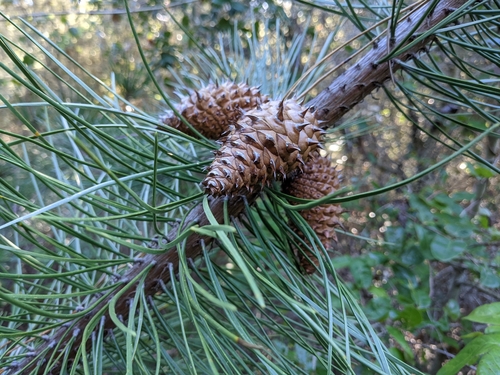
bishop pine
Pinus muricata
A rugged icon of the California coast, the Bishop Pine is a fire-adapted survivor that turns harsh sea winds into a twisted work of art. Its persistent, prickly cones hold the secrets of future forests, waiting for the heat of a flame to release their life.
Quick Identification
Size
15–25 meters (50–80 feet) tall with a trunk diameter of 0.6–0.9 meters (2–3 feet)
Colors
Dark green to bluish-green needles; dark grey-brown bark; reddish-brown to weathered grey cones
Key Features
- Needles in bundles of two, 2.5 to 6 inches long
- Asymmetric, prickly seed cones in whorls
- Deeply furrowed, dark grey-brown bark
- Serotinous cones that often remain closed for years
When You’ll See Them
Geographic range
Where Does the bishop pine Live?
The Bishop Pine is native to the western edge of North America, specifically hugging the coastline of California and parts of Baja California, Mexico. Its distribution is remarkably fragmented, found in disjunct groves from Humboldt County down to the Channel Islands and Cedros Island. Notably, in Marin County's Point Reyes, these trees are almost exclusively found on the western side of the San Andreas Fault, highlighting their specific geological preferences.
Basemap © OpenStreetMap contributors
Behavior
The Bishop Pine is a resilient coastal specialist characterized by its unique relationship with fire. Many of its stands are serotinous, meaning the cones are sealed with resin and only open to release seeds following the intense heat of a wildfire. This strategy allows the species to colonize charred landscapes quickly, ensuring a new generation of trees thrives when competition is low and nutrients are returned to the soil.
Its growth form is highly plastic, dictated by the harsh coastal environment. In sheltered inland areas, it grows straight and tall, while on exposed coastal bluffs, it often takes on a stunted, gnarled 'krummholz' shape due to constant salt spray and high winds. It serves as a critical structural component of coastal ecosystems, providing nesting sites for raptors and habitat for specialized insects.
EverydayEarth exclusive
Camera Tips
When using an AI camera to monitor a Bishop Pine, focus on the 'habitat hub' it creates. Position your camera 5–8 feet up the trunk or on a nearby post facing the mid-canopy or the trunk's bark. The deeply furrowed bark is a magnet for nuthatches, creepers, and woodpeckers looking for insects. Use a wide-angle lens to capture the unique 'whorls' of cones, which are a primary food source for squirrels and heavy-beaked birds like the Red Crossbill.
Because these trees live in the fog belt, moisture can often cloud your lens. Ensure your camera housing is well-sealed and consider a small rain shield or hood. The high-contrast bark and dark needles can sometimes trick auto-exposure settings; if your camera allows, set it to a center-weighted metering mode to avoid overexposing the sky through the branches.
For those interested in the tree's development, a long-term time-lapse is fascinating. Bishop Pines grow relatively quickly for conifers. If you are lucky enough to have a young tree, capturing the seasonal expansion of 'candles' (new growth tips) in the spring provides a wonderful look at the tree's life cycle. During the winter months, look for owls or hawks using the sturdy, wind-sculpted branches as hunting perches.
Similar Species
Species that look similar or are commonly confused with bishop pine.
Frequently Asked Questions
Record bishop pine at your habitat
Connect a camera to start building your own species record — AI identifies every visitor automatically.