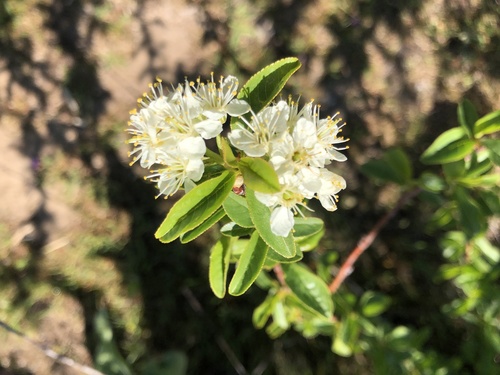
Bitter cherry
Prunus emarginata
A vital life-support system for western wildlife, the Bitter cherry draws in everything from hummingbirds to grizzly bears with its seasonal bounty of blossoms and berries.
Quick Identification
Size
A shrub or small tree growing 1-15 meters (3-49 feet) tall with a trunk diameter up to 30 cm (12 inches).
Colors
Reddish-brown to gray bark with prominent horizontal orange-tinted slits; bright green leaves; translucent red to dark purple fruit.
Key Features
- Finely serrated oval leaves with rounded or notched tips
- Bark marked by distinct horizontal lines called lenticels
- Small white flowers in flat-topped clusters of 3-10
- Intensely bitter, bright red pea-sized berries
When You’ll See Them
Geographic range
Where Does the Bitter cherry Live?
The Bitter cherry is a hallmark of western North America, stretching from the coastal forests of British Columbia down through the Pacific Northwest into the mountains of California and Baja California. Its range extends eastward into the Rocky Mountains, found frequently in Idaho, Montana, and as far south as New Mexico and Arizona. It is a resilient species that thrives in the diverse climates of the American West, from humid coastal lowlands to dry, high-altitude ridges.
Basemap © OpenStreetMap contributors
Behavior
The Bitter cherry is a fast-growing, deciduous pioneer species that often takes advantage of disturbed areas like recent burn sites or clear-cuts. It plays a vital role in forest succession, stabilizing the soil while providing a quick canopy for slower-growing species. While it is relatively short-lived compared to oaks or pines, its rapid growth ensures it produces a high volume of seeds in a short period, which are then dispersed widely by visiting wildlife.
As a seasonal hub of activity, the tree's behavior is dictated by its reproductive cycle. In spring, it erupts in fragrant white blossoms that attract a diverse array of pollinators. By late summer, the tree focuses its energy on developing clusters of bitter fruits. While the fruit is unpalatable to humans due to its extreme bitterness, it is a primary food source for many species, making the tree a central social and foraging spot for backyard birds and mammals alike.
EverydayEarth exclusive
Camera Tips
To capture the most action around a Bitter cherry, timing is everything. While the tree is present year-round, the "golden window" for wildlife activity is during the fruiting season from late July through September. During this time, set your camera to a "Burst" or "Video" mode to capture the quick, frantic movements of birds like Cedar Waxwings and Western Tanagers as they hover and pluck the berries. Mount your camera 4-6 feet high on a neighboring tree, aiming toward the outer branches where the fruit clusters are most dense.
Because the bark of the Bitter cherry is thin and somewhat reflective, nighttime flash can often result in a "blown-out" white image. To avoid this, angle your camera at a 45-degree offset from the main trunk rather than pointing it directly at the tree. If you are using an AI-powered camera like those from EverydayEarth, ensure the field of view includes a clear patch of ground beneath the tree; many mammals, including Mule Deer and Black Bears, will visit at night to forage for fallen fruit.
During the spring flowering phase (April-May), tighten your camera’s focus area to capture the intricate details of pollinators. Position the camera closer to a specific cluster of blossoms—about 2-3 feet away if your camera's minimum focus distance allows—to record the visitations of swallowtail butterflies and various native bees. This is the best time to utilize high-shutter-speed settings to freeze the motion of insect wings in the bright afternoon sun.
Similar Species
Species that look similar or are commonly confused with Bitter cherry.
Frequently Asked Questions
Record Bitter cherry at your habitat
Connect a camera to start building your own species record — AI identifies every visitor automatically.