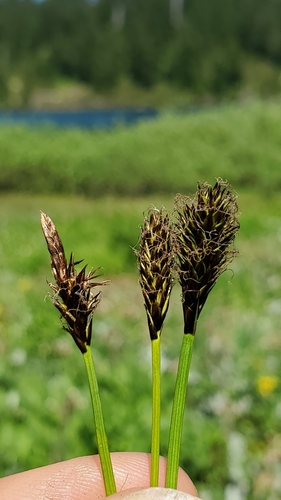
black alpine sedge
Carex nigricans
A hardy specialist of the high peaks, the black alpine sedge paints the mountain meadows with deep, chocolate-colored spikes. It is a master of survival, thriving in the cold shadows of lingering snowbanks where other plants dare not grow.
Quick Identification
Size
5 to 20 cm (2 to 8 inches) in height; leaves 1.5 to 3 mm wide
Colors
Bright green leaves with distinctive dark chocolate-brown to near-black terminal flower spikes
Key Features
- Single dense terminal flower spike, typically ovoid
- Densely tufted growth habit with thick creeping rhizomes
- Dark brown to blackish scales on the flower head
- Flat or channeled leaves that are shorter than the flowering stems
When You’ll See Them
Geographic range
Where Does the black alpine sedge Live?
The black alpine sedge is native to the high mountain regions of Western North America and Northeast Asia. In North America, its core range extends from Alaska and the Yukon southward through the British Columbia peaks into the Sierra Nevada of California and the Rocky Mountains of Colorado. It also populates the cold, mountainous regions of Eastern Russia and Northern Japan, where it is found exclusively in high-elevation zones above the treeline.
Basemap © OpenStreetMap contributors
Behavior
The black alpine sedge is a resilient perennial that plays a vital role in high-altitude ecosystems. Unlike many other plants that struggle with heavy snowpack, this species thrives in areas where snow lingers late into the summer, such as snowbeds and moist alpine meadows. It often forms dense, sod-like mats that help stabilize the thin, fragile soils of mountain slopes, preventing erosion during the spring thaw.
As a foundational member of the alpine community, its growth cycle is tied strictly to the melting of the snow. Once the ground is clear, it grows rapidly to take advantage of the short mountain growing season. While it doesn't 'behave' in the animal sense, it interacts significantly with its environment by providing a primary food source for high-altitude herbivores like pikas and marmots, who graze on the nutritious young shoots.
EverydayEarth exclusive
Camera Tips
To capture the growth of black alpine sedge, you must think low and close. Because these plants rarely exceed 8 inches in height, place your camera on a mini-tripod or a flat, stable rock at ground level. Angle the lens slightly upward to showcase the dark flower spikes against the backdrop of the mountain sky or distant peaks. This perspective emphasizes the 'forest' of sedge and makes for a much more dramatic shot than a top-down view.
Time-lapse is the best setting for this species. Given how quickly alpine plants respond to snowmelt, setting your camera to take one photo every 2 to 4 hours can create a stunning sequence of the spikes emerging and turning their signature dark color. If you are using a trail camera with AI triggers, set the sensitivity to high; while the plant itself won't trigger the camera, the pikas and ground squirrels that come to forage on it certainly will, allowing you to capture the plant's role in the local food web.
Pay close attention to the lighting. The dark chocolate scales of the black alpine sedge can easily lose detail in harsh midday sun, appearing as a solid black blob. The best 'golden hour' for these plants is late afternoon when the sun is low, which highlights the texture of the spikes and the vibrant green of the surrounding meadow. If your camera allows for macro settings, use them to capture the intricate details of the perigynia (the bottle-shaped structures around the seeds).
Similar Species
Species that look similar or are commonly confused with black alpine sedge.
Frequently Asked Questions
Record black alpine sedge at your habitat
Connect a camera to start building your own species record — AI identifies every visitor automatically.