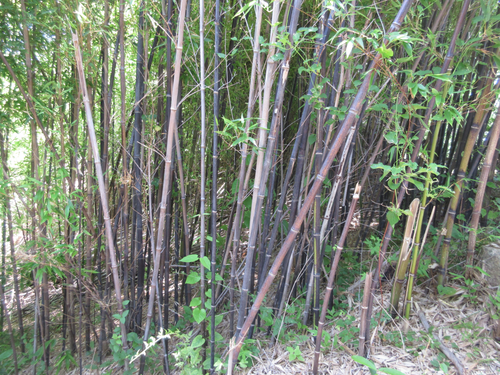
Black Bamboo
Phyllostachys nigra
With its polished ebony canes and delicate emerald leaves, Black Bamboo is a living masterpiece of the botanical world. A favorite for both garden design and wildlife cover, this rapid-growing giant offers a unique architectural beauty that transforms any backyard into a serene woodland retreat.
Quick Identification
Size
Height: 3–7 meters (10–23 feet); Culm diameter: 2–4 centimeters (0.8–1.6 inches)
Colors
Culms transition from bright green to polished jet-black or deep purple-black over 2-3 years; foliage is a vibrant, contrasting emerald green.
Key Features
- Culms transition from green to ebony black with age
- Dense, feathery green leaves providing a striking color contrast
- Persistent culm sheaths that fall away as the plant matures
- Vigorous running rhizome system that forms dense thickets
When You’ll See Them
Geographic range
Where Does the Black Bamboo Live?
Originally native to the Hunan Province of China, Black Bamboo has become a global favorite in temperate and subtropical climates. It is now widely cultivated across East Asia, including Japan and Korea, and has established significant introduced populations throughout the United States, Europe, and Australia. In many regions, it thrives in USDA hardiness zones 7 through 10, frequently escaping garden cultivation to form dense stands along forest edges and suburban creek lines where moisture is plentiful.
Basemap © OpenStreetMap contributors
Behavior
Black Bamboo is a perennial evergreen known for its striking aesthetic and vigorous growth. Unlike many other plants, its most distinct feature—the black color—is a developmental process; new shoots emerge from the soil a bright green and slowly darken over two to three years as they are exposed to sunlight and mature. This species is a 'running' bamboo, meaning it spreads via underground rhizomes, potentially forming dense, monolithic groves that provide excellent cover for small birds and mammals.
In a backyard setting, Black Bamboo is highly reactive to its environment. It sways gracefully in light winds, creating a distinct rustling sound often sought after for meditative or 'zen' gardens. While it lacks sentient behavior, its rapid growth during the spring shooting season is a spectacle of nature, with culms sometimes growing several inches in a single day under ideal conditions. Humans must manage its spreading nature carefully, as its rhizomes can easily travel under fences and walls if not contained by high-quality root barriers.
EverydayEarth exclusive
Camera Tips
Capturing Black Bamboo on a backyard camera is less about 'catching' the plant and more about documenting its incredible growth rate and its role as a wildlife hub. During the spring shooting season (typically March to May), set your camera to time-lapse mode. Position the camera on a tripod or a low stake about 3 feet away from a newly emerging shoot. By taking a frame every 30 to 60 minutes, you can create a stunning video of the culm 'telescoping' upward, a process that is often too slow for the naked eye but looks like a cinematic miracle on film.
Because the black culms are highly reflective once they mature, avoid using a direct, high-intensity infrared flash at night, which can cause 'white-out' on the polished surface of the canes. Instead, position your camera at a 45-degree angle to the grove rather than head-on to capture the texture and depth of the canes. If you are using an AI-powered camera to detect wildlife, Black Bamboo makes an excellent 'backstop.' The dense, dark canes provide a high-contrast background that makes the colors of visiting birds, like Northern Cardinals or Blue Jays, pop in your photos.
Keep in mind that bamboo leaves move constantly in even the slightest breeze. To prevent thousands of 'false trigger' videos, adjust your camera's motion sensitivity to a medium setting or use 'zone detection' to exclude the swaying tops of the bamboo. Focus your trigger zone on the base of the culms where ground-dwelling animals like rabbits, squirrels, or towhees are likely to forage among the leaf litter. In the winter, the evergreen leaves provide a rare splash of color in the frame, making it a great focal point for snowy backyard shots when most other vegetation is dormant.
Similar Species
Species that look similar or are commonly confused with Black Bamboo.
Frequently Asked Questions
Record Black Bamboo at your habitat
Connect a camera to start building your own species record — AI identifies every visitor automatically.