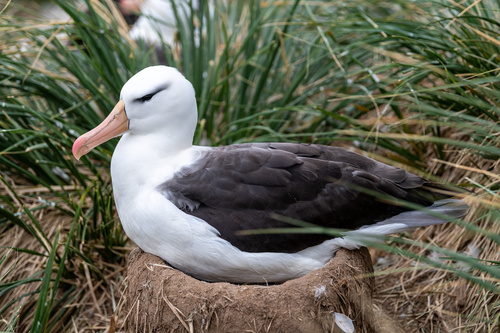
Black-browed Albatross
Thalassarche melanophris
The Black-browed Albatross is the master of the Southern Ocean, known for its incredible 2-meter wingspan and striking, soulful 'eyebrow' markings. A symbol of endurance, these birds spend years at sea before returning to rugged cliffs to find their lifelong mates.
Quick Identification
Size
Length of 80–95 cm (31–37 in), wingspan of 2–2.4 m (6.6–7.9 ft), and weight ranging from 2.9–4.7 kg (6.4–10.4 lb).
Colors
Pure white head and body with dark grey-black upperwings and tail. It features a bright yellow-orange bill with a pink tip and a distinctive dark smudge around the eye.
Key Features
- Signature dark 'eyebrow' streak across the eye
- Bright orange-yellow bill with a reddish-pink tip
- Mostly white underwing with thick black leading and trailing edges
- Large, stocky build compared to other mollymawks
When You’ll See Them
Geographic range
Where Does the Black-browed Albatross Live?
The Black-browed Albatross is a resident of the vast Southern Ocean, circumnavigating the globe between the subtropical and Antarctic waters. They are most commonly seen off the coastlines of South America, Australia, New Zealand, and South Africa, with the majority of the world's population breeding on the Falkland Islands, South Georgia, and the Diego Ramírez Islands. While they are southern specialists, rare vagrants are occasionally recorded as far north as the North Atlantic and European coastlines.
Basemap © OpenStreetMap contributors
Behavior
Black-browed Albatrosses are the most iconic gliders of the Southern Hemisphere, utilizing dynamic soaring to travel thousands of miles with barely a flap of their wings. They are highly social and opportunistic, frequently congregating in massive, noisy 'mobs' behind fishing vessels to scavenge for scraps. While they are silent and solitary at sea, they become incredibly expressive during the breeding season, engaging in rhythmic bill-clapping and sky-pointing displays to reinforce pair bonds.
These birds are famous for their colonial nesting habits, often forming dense 'cities' on steep, windswept cliffs alongside Rockhopper Penguins. They are monogamous and exhibit high site fidelity, returning to the same mud-pillar nest year after year. Despite their remote lives, they are curious birds and will often glide close to ships or coastal observers, showing little fear of humans.
EverydayEarth exclusive
Camera Tips
Capturing a Black-browed Albatross on a trail or backyard camera is a unique challenge that requires a coastal vantage point. Because these birds use coastal updrafts to glide along cliff edges, place your camera on a high-elevation tripod or mount it to a fence post facing the prevailing wind. High shutter speeds are essential; if your camera has a 'Sports Mode' or adjustable AI triggers, set them to the fastest possible capture to freeze their 2-meter wingspan in flight.
For users with properties overlooking the ocean, the best strategy is to aim cameras toward the 'horizon line' where the sky meets the sea, or toward prominent rocky outcrops where they may land to rest. Since their white plumage is highly reflective, you must adjust your camera's exposure compensation to -1.0 or -2.0 during midday to prevent the feathers from looking like a white blob. The golden hours of dawn and dusk provide the most dramatic lighting for their orange bills and dark eye-smudges.
Avoid using bait, as this can be harmful to seabirds and is often regulated. Instead, look for natural activity like local fishing boats or kelp forests which naturally attract them. If you are lucky enough to be near a colony, focus your camera on the landing strips—open patches of grass or rock where they touch down. Use a wide-angle lens for flight shots to capture their immense scale against the ocean backdrop.
Similar Species
Species that look similar or are commonly confused with Black-browed Albatross.
Frequently Asked Questions
Record Black-browed Albatross at your habitat
Connect a camera to start building your own species record — AI identifies every visitor automatically.