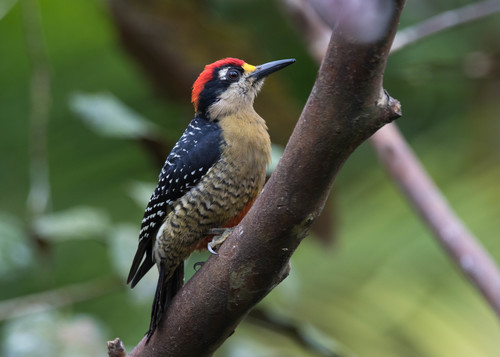
Black-cheeked Woodpecker
Melanerpes pucherani
With its striking zebra-striped back and vibrant red accents, the Black-cheeked Woodpecker is a crown jewel of the tropical forest edge. A social and vocal visitor, this bird turns any backyard into a lively tropical paradise.
Quick Identification
Size
Length of 18–19 cm (7.1–7.5 in); weight ranges from 42 to 63 g (1.5–2.2 oz)
Colors
Black and white barred back; yellow forehead; red belly; males have a full red crown, while females have a black crown with red only on the nape
Key Features
- Prominent black 'cheek' patch through the eye
- Yellow patch at the base of the bill
- Zebra-like black and white barring on the wings and back
- Vibrant red patch on the lower belly
When You’ll See Them
Geographic range
Where Does the Black-cheeked Woodpecker Live?
Native to the lush tropical regions of the Americas, the Black-cheeked Woodpecker thrives across a corridor stretching from southern Mexico through Central America. Its core range includes the humid lowlands of countries like Costa Rica, Panama, and Nicaragua, extending southward into western Colombia and the Pacific slope of Ecuador. Because it favors wet, tropical environments, it is rarely found far from the humid forest belt that defines these regions.
Basemap © OpenStreetMap contributors
Behavior
The Black-cheeked Woodpecker is a highly social and conspicuous bird, often seen in pairs or small family groups rather than alone. They are more arboreal than many other woodpeckers, frequently foraging high in the canopy or on the outer branches of trees. They are known for their noisy presence, often announcing themselves with a series of rattling 'kerrrr-uck' calls that can be heard from a significant distance.
Unlike many of its cousins that focus strictly on wood-boring larvae, this species is quite adventurous. They are frequently observed visiting bird feeders, especially those offering fruit or nectar. In a backyard setting, they are relatively bold and will often tolerate human presence if they have a reliable food source, making them a favorite for enthusiasts with patio-mounted cameras.
EverydayEarth exclusive
Camera Tips
To capture the best footage of a Black-cheeked Woodpecker, mount your camera vertically on the trunk of a soft-wood tree or a tall, dead snag. These birds prefer to land on vertical surfaces and hitch their way upward. Placing the camera about 6 to 10 feet off the ground, angled slightly upward toward a known drumming or nesting site, will yield the most intimate 'eye-level' perspectives of their foraging behavior.
Because this species is a fruit lover, you can significantly increase your capture rate by using 'lure stations.' Secure half an orange or a ripe plantain to a branch within the camera's field of view. Unlike seed-eating birds, Black-cheeked Woodpeckers will spend several minutes at a time methodically pecking at fruit, providing excellent long-form video clips. Ensure your camera is set to a high-speed trigger mode, as their head movements while feeding are extremely rapid.
Lighting is crucial in the dense, humid environments they inhabit. Try to position your camera in a spot that receives 'dappled' morning light. The bright yellow forehead and red crown can easily overexpose in direct midday sun, but early morning light highlights the iridescent quality of their black feathers. If your camera allows for it, set a slightly higher shutter speed to avoid motion blur during their characteristic 'hitching' movements up the bark.
Similar Species
Species that look similar or are commonly confused with Black-cheeked Woodpecker.
Frequently Asked Questions
Record Black-cheeked Woodpecker at your habitat
Connect a camera to start building your own species record — AI identifies every visitor automatically.