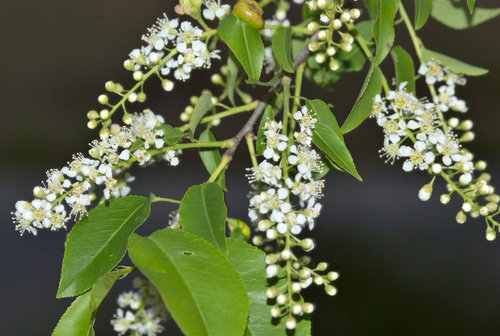
black cherry
Prunus serotina
The Black Cherry is the ultimate backyard wildlife hub, offering a seasonal feast for everything from songbirds to foxes with its abundant, dark summer fruit.
Quick Identification
Size
Height of 15–24 m (50–80 ft); trunk diameter of 0.3–1.2 m (1–4 ft)
Colors
Glossy dark green leaves; white spring blossoms; dark grey to black 'burnt' bark; deep purple to black ripened fruit.
Key Features
- Rough, dark, scaly bark on mature trees resembling burnt potato chips
- Long, drooping white flower clusters (racemes) appearing in spring
- Narrow, ovate leaves with a rusty-colored fuzz along the midrib on the underside
- Twigs and leaves have a distinct bitter almond scent when crushed or broken
When You’ll See Them
Geographic range
Where Does the black cherry Live?
This iconic tree is native to the North American continent, boasting a massive range that extends from the maritime provinces of Canada down through the eastern United States to Florida. It further stretches westward to the Great Plains and continues south into the mountainous regions of Mexico and Guatemala. While it is a quintessential part of the Appalachian and Eastern hardwood forests, it has also become naturalized in parts of Europe and South America, where it is often studied for its vigorous growth and adaptability.
Basemap © OpenStreetMap contributors
Behavior
The black cherry is a fast-growing, opportunistic 'pioneer' species that often takes hold in sunny gaps within a forest canopy or along the edges of suburban landscapes. Unlike many other hardwoods, it thrives on disturbance, quickly establishing itself in abandoned fields or areas cleared by storms. It plays a critical role in the forest ecosystem by producing a massive annual crop of fruit that serves as a primary food source for dozens of species during the late summer months.
While the tree itself is stationary, it exhibits fascinating biological cycles that dictate the movement of local wildlife. In the spring, its heavy nectar production attracts a variety of pollinators, while in the fall, its foliage provides a larval host for several iconic butterflies, including the Eastern Tiger Swallowtail. Humans have long interacted with the black cherry for its high-quality timber—prized for its deep reddish-brown hue—and its fruit, which has historically been used to flavor jams, jellies, and spirits like cherry bounce.
EverydayEarth exclusive
Camera Tips
To capture the diverse wildlife attracted to a black cherry tree, camera placement is everything. During the late summer (August through September), position your camera to focus on low-hanging branches laden with ripe, dark fruit. If you have a trail camera with a high-resolution sensor, try mounting it 5–7 feet up a neighboring tree, angled slightly downward toward a cluster of berries. This is the best way to record the flurry of activity from Cedar Waxwings, Rose-breasted Grosbeaks, and Northern Cardinals.
Don't just look up, though. The 'drip line'—the area on the ground directly beneath the tree's outer branches—is a goldmine for terrestrial wildlife. Fallen cherries are an irresistible lure for mammals. Place a camera 12–18 inches off the ground, aimed at the base of the trunk or a clear patch of ground under the canopy. You are likely to capture Gray Foxes, Raccoons, Opossums, and even Black Bears gorging on the fermenting fruit during the night.
Because the action at a fruiting black cherry can be fast and chaotic, use a 'burst' or 'multi-shot' mode with at least 3 photos per trigger. If your camera supports video, sets of 15-second clips are ideal for observing feeding behavior. Ensure your shutter speed is set to high if possible, as birds moving through the branches can easily become a blur in low-light conditions. In the spring, you can also aim cameras at the blossoms to capture pollinators and early-season insectivores.
Similar Species
Species that look similar or are commonly confused with black cherry.
Frequently Asked Questions
Record black cherry at your habitat
Connect a camera to start building your own species record — AI identifies every visitor automatically.