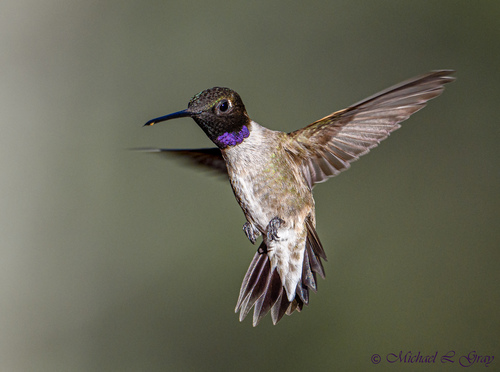
Black-chinned Hummingbird
Archilochus alexandri
The Black-chinned Hummingbird is a master of the air, known for its rhythmic tail-pumping and a hidden flash of brilliant purple. A staple of western backyards, these tiny gems bring high-speed drama to every garden they visit.
Quick Identification
Size
Length: 8.2–9 cm (3.2–3.5 in); Wingspan: ~11-13 cm (4.3-5.1 in); Weight: 2.3–4.9 g (0.08–0.17 oz)
Colors
Males have metallic green backs, white underparts, and a black throat with a hidden purple iridescent band. Females are metallic green above with pale gray-white underparts and white-tipped tail feathers.
Key Features
- Velvet black throat with a thin, iridescent purple band visible in direct light
- Slender, slightly decurved bill
- Frequent rhythmic pumping of the tail while hovering
- Distinctive low-pitched humming sound made by wings in flight
When You’ll See Them
Geographic range
Where Does the Black-chinned Hummingbird Live?
Native to western North America, the Black-chinned Hummingbird occupies a vast breeding range that stretches from the southern interior of British Columbia through the western United States and into northern Mexico. They are the most widespread hummingbird in the western U.S., found from the Pacific coast to the eastern edge of the Rocky Mountains. As migratory birds, they travel south to spend the winter months primarily in western and south-central Mexico.
Basemap © OpenStreetMap contributors
Behavior
Black-chinned Hummingbirds are high-energy aerial acrobats, spending much of their day darting between nectar sources. They are particularly known for their 'tail-wagging' habit—a rhythmic pumping of the tail while hovering that sets them apart from many other species. This constant motion makes them a lively addition to any backyard, though they are often seen resting on high, exposed twigs between feeding bouts.
While they may seem delicate, they are fiercely territorial. A single male will often guard a feeder or a patch of flowering shrubs from all intruders, including larger birds. During the breeding season, males perform dramatic U-shaped diving displays, climbing up to 100 feet in the air before plunging downward to impress females or ward off rivals. They are generally tolerant of humans and will often approach feeders even while you are nearby.
EverydayEarth exclusive
Camera Tips
To capture the rapid movement of a Black-chinned Hummingbird, position your AI-powered camera approximately 12 to 18 inches away from a nectar feeder or a cluster of native tubular flowers like Salvia or Desert Willow. Because these birds move with lightning speed, use a camera with a high frame rate or a 'pre-capture' feature. If your camera allows for shutter speed manual overrides, aim for 1/2000th of a second or faster to freeze the wing motion, or 1/500th if you want to show a beautiful motion blur.
Lighting is the most critical factor for this species. To see the male's signature purple throat band (the gorget), the camera should be positioned so the sun is behind it, shining directly onto the bird's throat. Without direct sunlight hitting the feathers at the correct angle, the throat will simply look matte black. Early morning or late afternoon light provides the best warm tones and reduces harsh shadows that can hide detail on their metallic green backs.
For the best 'natural' shots, place your camera near a perching twig located about 3-5 feet away from a feeder. Hummingbirds are creatures of habit and will often return to the same twig to survey their territory and digest nectar. This provides a rare moment of stillness for high-quality portraits. Ensure the background is at least 10 feet away to create a soft, blurred effect (bokeh) that makes the bird's tiny frame pop.
During the peak of summer, keep your feeders clean and the sugar-water fresh, as these birds have high metabolisms and will visit reliable stations every 15-20 minutes. If you are using an AI trigger, ensure it is set to a high sensitivity level, as their small size can sometimes be missed by PIR sensors designed for larger mammals.
Similar Species
Species that look similar or are commonly confused with Black-chinned Hummingbird.
Ruby-throated Hummingbird
Found primarily in the East; males have a bright red gorget instead of the Black-chin's purple band.
Anna's Hummingbird
Larger and stockier; males have rose-pink feathers covering both the throat and the entire crown.
Costa's Hummingbird
Smaller with a much shorter tail; males have a brilliant violet gorget with long 'mustache' feathers extending to the sides.
Frequently Asked Questions
Record Black-chinned Hummingbird at your habitat
Connect a camera to start building your own species record — AI identifies every visitor automatically.