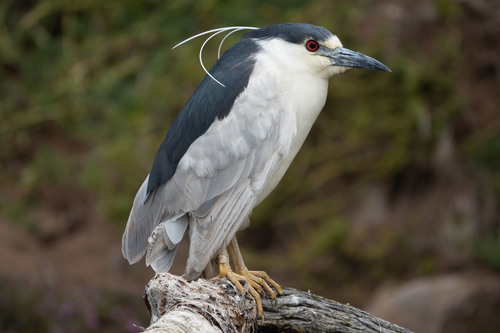
Black-crowned Night Heron
Nycticorax nycticorax
A secretive master of the shadows, the Black-crowned Night Heron is famous for its striking red eyes and nocturnal hunting prowess. Whether stalking a suburban koi pond or a remote marsh, this stocky bird is a fascinating backyard visitor for those who know where to look.
Quick Identification
Size
Length: 58–66 cm (23–26 in); Wingspan: 115–118 cm (45–46 in); Weight: 727–1,014 g (1.6–2.2 lbs)
Colors
Adults have a black crown and back, grey wings, and white underparts. Juveniles are streaky brown with large white spots.
Key Features
- Stocky build with a short neck and legs
- Bright red eyes in adults
- Two or three long white head plumes during breeding
- Black cap and back contrasting with pale grey wings
When You’ll See Them
Sightings on EverydayEarth
Jul 22, 2026
Two Black-crowned Night Herons are perched among the dense foliage of a tree in the Florida swamp at night. They remain largely motionless, occasionally shifting their heads while resting in their typical hunched posture.
Jul 22, 2026
In the infrared nighttime view, two herons are seen perched among the dense cypress foliage. The bird on the left becomes active, stretching its neck and shifting its weight on the branch, while the second bird to the right remains tucked and motionless.
Jul 22, 2026
Several Black-crowned Night Herons are seen perched among the branches of a tree at night. They are mostly stationary, with some birds occasionally turning their heads or looking down into the foliage below.
Jul 21, 2026
Two Black-crowned Night Herons are seen perched in a tree at night. The heron on the left is busy preening its feathers, while the second bird rests quietly further to the right among the dense foliage.
Jul 21, 2026
Several wading birds are roosting in a tree over the swamp at night. A Black-crowned Night Heron perches prominently in the upper center of the frame, while a Roseate Spoonbill and other herons are nestled deeper within the foliage below. The birds are mostly stationary, occasionally shifting their heads or adjusting their positions on the branches.
Jul 21, 2026
In the quiet darkness of the swamp, two Black-crowned Night Herons are roosting among the thick evergreen branches. The bird in the upper portion of the frame is clearly visible, maintaining a still, hunched posture typical of the species, occasionally shifting its head. A second individual is tucked into the foliage in the lower-right quadrant, mostly obscured by the vegetation.
Geographic range
Where Does the Black-crowned Night Heron Live?
This cosmopolitan heron boasts one of the widest distributions of any wading bird, claiming territory across nearly every continent except Australia and Antarctica. In the Americas, they are found from the southern reaches of Canada all the way through South America to Tierra del Fuego. Across the Atlantic, their presence spans much of Europe, Africa, and Asia, where they thrive in diverse wetland ecosystems ranging from tropical mangroves to temperate marshes. While northern populations are migratory, moving south to avoid freezing waters, many populations in warmer climates remain year-round residents.
Basemap © OpenStreetMap contributors
Behavior
The Black-crowned Night Heron is a master of the 'sit and wait' foraging strategy. Unlike many other herons that actively stalk their prey through the shallows, these birds often stand perfectly motionless on a branch or at the water's edge for long periods, waiting for an unsuspecting fish or frog to swim within reach. While they are primarily nocturnal to avoid competition with larger daytime herons, they are frequently seen at dawn and dusk, or even during the day during the demanding breeding season.
Socially, they are quite gregarious and prefer to nest in noisy colonies, often called rookeries, alongside other wading birds like egrets and ibises. Though they generally keep a low profile around humans, they have adapted remarkably well to urban environments, frequently visiting city parks with ponds or suburban canals where food is plentiful. Their call is a distinctive, harsh 'quock' sound that is often heard overhead as they fly to their feeding grounds at sunset.
EverydayEarth exclusive
Camera Tips
To capture the elusive Black-crowned Night Heron on your backyard camera, position your device near the water’s edge, ideally directed at a protruding log, a low-hanging branch over a pond, or a shallow muddy bank. Since these birds are primarily nocturnal, ensure your camera has high-quality infrared (IR) or 'no-glow' flash capabilities. This allows you to get crisp black-and-white nighttime shots without startling the bird with a bright white light. Set the camera at a low height—about 12 to 18 inches off the ground—to capture their characteristically low-slung, 'hunched' hunting posture.
While herons won't come to traditional seed feeders, you can 'lure' them by choosing locations with high natural prey activity. If you have a backyard pond, placing your camera near a shallow shelf where goldfish, minnows, or frogs congregate is your best bet. Because they are sit-and-wait predators, herons may stand still for minutes at a time; use a short trigger delay or a 'burst mode' (3-5 photos per trigger) to increase your chances of catching the lightning-fast strike when they finally lunge for prey.
Seasonal timing is crucial if you live in a northern climate; your best chance for activity is during the spring and summer breeding months when parents are hunting more frequently to feed their chicks. In suburban settings, these herons are surprisingly predictable and will often visit the exact same backyard pond at the same hour every night. Check your footage for consistent patterns and refine your camera's angle to capture the perfect reflection of those striking red eyes in the water.
Similar Species
Species that look similar or are commonly confused with Black-crowned Night Heron.
Yellow-crowned Night Heron
Has a distinct white cheek patch and a yellowish-white crown compared to the solid black crown of its cousin.
Green Heron
Smaller and more slender with a chestnut-colored neck and dark greenish-blue plumage.
Great Blue Heron
Much larger with longer legs and a longer, thinner neck, and is primarily active during the day.
Frequently Asked Questions
Record Black-crowned Night Heron at your habitat
Connect a camera to start building your own species record — AI identifies every visitor automatically.