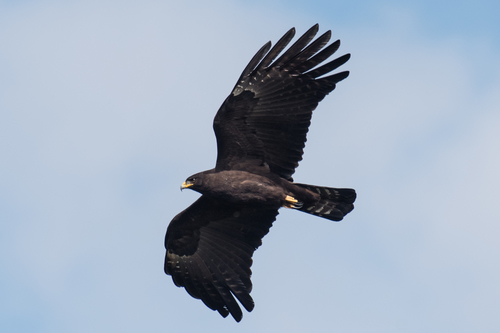
Black Eagle
Ictinaetus malaiensis
The phantom of the Asian canopy, the Black Eagle is a master of slow-motion flight and specialized nest hunting. With its massive, finger-like wings and striking yellow accents, it is one of the most mesmerizing raptors to spot soaring over hilly forest ridges.
Quick Identification
Size
Length: 26–32 inches (67–81 cm); Wingspan: 5.4–5.8 feet (164–178 cm); Weight: 2.2–3.5 lbs (1–1.6 kg)
Colors
Uniformly sooty black plumage; striking yellow cere and feet contrast with the dark feathers; pale barring on tail and underwing covers visible in good light.
Key Features
- Extremely long, widely splayed primary "fingers"
- Distinctive yellow cere and legs against dark plumage
- Silvery-grey barring on the underside of the tail and flight feathers
- Unique flight silhouette with wings often held in a slight "V" shape
When You’ll See Them
Geographic range
Where Does the Black Eagle Live?
Native to the tropical and subtropical regions of Asia, the Black Eagle thrives across a massive range spanning from the foothills of the Himalayas to the lush islands of Indonesia. It is commonly found throughout India, Sri Lanka, and Southeast China, extending southward through the Malay Peninsula and across the Greater Sunda Islands. These majestic raptors are strictly forest-dwellers, favoring the rugged, hilly terrain of primary and secondary forests where they can soar over the canopy undisturbed.
Basemap © OpenStreetMap contributors
Behavior
The Black Eagle is a specialized hunter of the forest canopy, known for its distinctive and remarkably slow soaring flight. Unlike many other eagles that rely on speed or ambush, this species drifts languidly over hilly terrain, its broad wings allowing it to stay aloft with minimal effort as it scans the treetops for nests. It is particularly famous for being a "nest robber," often using its uniquely shaped, curved outer toes to snatch eggs or entire nests from the branches.
While largely solitary or found in pairs, these eagles are not aggressive toward humans but are generally shy, preferring the undisturbed cover of dense evergreen and deciduous forests. They spend much of their day on the wing, utilizing thermals to patrol their large territories, and are rarely seen perching in the open compared to other large raptors.
EverydayEarth exclusive
Camera Tips
Capturing a Black Eagle on a backyard or trail camera requires a strategic approach, as these birds spend the majority of their time high above the forest floor. To increase your chances, place your camera in high-elevation clearings or on ridge lines where the eagle might soar close to the tree line. If you have a property with tall, emergent trees that tower over the rest of the canopy, aim your camera toward these specific branches, as they serve as occasional lookout points or nesting sites.
Because they are specialized nest predators, they are less likely to be attracted to standard ground-level meat baits. Instead, look for natural "hotspots" like areas with high concentrations of squirrel activity or colonies of nesting birds. Mounting your camera at a slight upward angle (15-30 degrees) on a high branch or overlooking a steep valley can help capture their unique silhouette as they glide by at eye level. High-shutter-speed settings are essential to counteract the motion blur of their wide wingspan, even during their characteristically slow flight.
The best time to capture activity is during the mid-morning when rising thermals allow them to begin their daily patrol. In terms of seasonality, the breeding season (varying by region but often between November and May) is the most active time, as they will be more localized around a specific nesting territory. Ensure your camera is set to a multi-shot burst mode; these eagles are large, and a single frame might only catch a wing-tip as they pass through the field of view.
Similar Species
Species that look similar or are commonly confused with Black Eagle.
Crested Serpent Eagle
Smaller with a distinct white trailing edge on the wings and a loud, piercing call compared to the silent soaring of the Black Eagle.
Changeable Hawk-Eagle (Dark Morph)
Dark morphs lack the extremely long primary 'fingers' and have shorter, broader wings and a different tail-to-wing ratio.
Indian Spotted Eagle
Browner in coloration with shorter wings and lacks the specialized curved toes of the Black Eagle.
Frequently Asked Questions
Record Black Eagle at your habitat
Connect a camera to start building your own species record — AI identifies every visitor automatically.