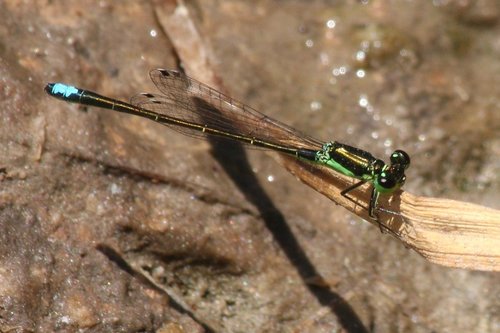
Black-fronted Forktail
Ischnura denticollis
A tiny, vibrant sentinel of the water's edge, the Black-fronted Forktail is a master of the reeds. Known for its solid black thorax and brilliant blue tail-tip, this delicate damselfly is a favorite for backyard pond enthusiasts.
Quick Identification
Size
23–31 mm (0.9–1.2 inches) in length with a wingspan of approximately 30–35 mm (1.2–1.4 inches)
Colors
Males have a solid black dorsal thorax with blue or green sides and a bright blue tip on the abdomen. Females are dichromatic, appearing bright orange when young and transitioning to olive-green or grayish-blue as they mature.
Key Features
- Solid black top of the thorax without pale stripes
- Bright blue segments 8 and 9 at the end of the male's abdomen
- Extremely small, needle-thin body
- Immature females often exhibit a striking bright orange coloration
When You’ll See Them
Geographic range
Where Does the Black-fronted Forktail Live?
Native to North and Central America, the Black-fronted Forktail is a characteristic species of the Western United States and Mexico. Its range extends from the California coast and the Great Basin through the Southwestern deserts into the highlands of Guatemala and Honduras, where it remains a common resident near permanent water sources.
Basemap © OpenStreetMap contributors
Behavior
The Black-fronted Forktail is a low-flying specialist that spends most of its life weaving through the safety of dense reeds and shoreline grasses. Unlike larger dragonflies that patrol the centers of ponds, this damselfly sticks to the margins, staying just inches above the water or ground to avoid predators and wind. They are most active during the warmth of mid-day when they can be seen darting quickly between perches or hovering momentarily to inspect a potential meal.
In terms of social interaction, these damselflies are primarily solitary except during mating. You may observe them in 'tandem,' where the male uses his tail appendages to clasp the female behind the head. This behavior, along with their tendency to 'glean' small insects directly off of leaves rather than catching them mid-air, makes them a fascinating subject for those patient enough to watch the micro-movements of a backyard pond ecosystem.
EverydayEarth exclusive
Camera Tips
To capture the Black-fronted Forktail on a backyard camera, you must focus on 'micro-habitats.' These insects are very small, so a standard wide-angle trail camera won't pick up much detail. Use a camera with a dedicated macro lens or a close-focusing distance of less than 12 inches. Position your camera on a small tripod at the edge of a pond, aiming the lens at the tips of emergent grasses or sunny 'basking stones' where damselflies like to rest.
Lighting is the most critical factor for a clear identification. Set up your camera in a spot that receives direct sunlight between 11 AM and 3 PM. The bright light will make the male's iridescent blue tail 'pop' against the green vegetation, helping AI detection software distinguish the insect from the background. Avoid areas with heavy shade, as the damselflies will be less active and the black thorax will blend into the shadows.
While you can't use traditional bait, you can 'aquascape' to attract them. Place a few thin, dry bamboo stakes or tall grasses in a sunny corner of your pond. These serve as perfect perching spots. Because Black-fronted Forktails are sensitive to motion, using a remote-triggered camera or a high-speed motion sensor is better than trying to approach them manually. If your camera allows, use a high shutter speed (at least 1/1000s) to freeze their rapid wing movements.
Seasonality plays a big role in your success. In warmer climates like Arizona or Mexico, they can be seen year-round, but in more temperate zones, focus your efforts during the peak of summer. Check your camera daily for 'tandem' pairs; capturing two damselflies joined together is a great way to confirm the species, as the male and female colorations are often found together in these positions.
Similar Species
Species that look similar or are commonly confused with Black-fronted Forktail.
Frequently Asked Questions
Record Black-fronted Forktail at your habitat
Connect a camera to start building your own species record — AI identifies every visitor automatically.