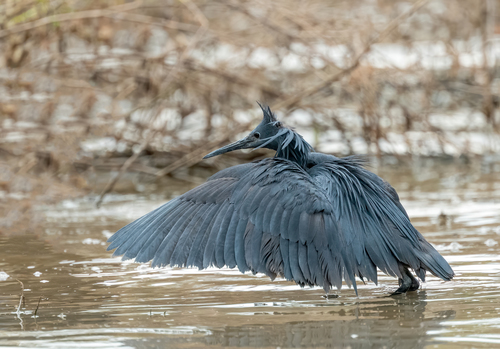
Black Heron
Egretta ardesiaca
Witness the 'Umbrella Bird' of the African wetlands. The Black Heron is a master of deception, using its own wings to create the shade it needs to hunt.
Quick Identification
Size
Length 42–50 cm (16–20 in); wingspan 90–95 cm (35–37 in); weight 270–390 g (9.5–13.8 oz)
Colors
Entirely slate-black plumage with a bluish tint; legs are black but the feet are bright yellow or orange
Key Features
- Distinctive 'canopy' hunting posture with wings spread over the head
- Uniform charcoal-black plumage without white patches
- Bright yellow or orange feet contrasting with dark legs
- Short, shaggy crest on the nape of the neck
When You’ll See Them
Geographic range
Where Does the Black Heron Live?
Native to the African continent, the Black Heron is a widespread resident throughout Sub-Saharan Africa, with core populations stretching from Senegal across to Ethiopia and southward to South Africa. These birds are most commonly found in the lush wetlands of the Okavango Delta, the Great Rift Valley lakes, and the coastal regions of Madagascar. While they are highly mobile and follow seasonal rains to find flooded plains, they are generally absent from the driest deserts and the most densely forested regions of the Congo Basin.
Basemap © OpenStreetMap contributors
Behavior
The Black Heron is globally famous for its unique foraging method known as 'canopy feeding.' It walks slowly through shallow water and then suddenly freezes, pulling its wings forward and over its head to form an umbrella-like circle. This creates a patch of shade that serves two purposes: it reduces surface glare so the heron can see its prey more clearly, and it lures small fish into the shade, thinking they have found a safe hiding spot.
While they are primarily solitary hunters, Black Herons are quite social during their off-hours. They often roost in large communal colonies, frequently sharing nesting sites with other species like Cattle Egrets or Squacco Herons. They are generally quiet birds, but they may emit a soft 'cluck' or croak during the breeding season or when defending a prime fishing spot from a rival.
EverydayEarth exclusive
Camera Tips
To capture the Black Heron’s iconic canopy behavior, place your camera at the very edge of a shallow water body, no more than 10-15 centimeters deep. The camera should be mounted low to the ground—about knee height—and angled slightly upward to capture the underside of the 'umbrella' when the bird strikes. Avoid placing the camera where it faces directly into the sun; the Heron's dark plumage is notorious for absorbing light, making it look like a featureless black silhouette if the lighting isn't soft and indirect.
Timing is critical for these birds. They are most active in the mid-morning and late afternoon when the sun is at an angle, which actually makes their shade-hunting technique more effective. Set your camera to a 'Burst' or 'Rapid Fire' mode. The transition from a standing bird to a full canopy happens in a split second, and you will need a fast trigger speed to catch the wings fully extended before the heron strikes into the water.
Since Black Herons are wary of movement, ensure your camera is well-camouflaged with local reeds or grasses. If you are setting up in a backyard or private pond in their range, you don't necessarily need bait, but maintaining a healthy population of small minnows or tilapia will keep them returning to the same spot daily. High-definition video mode is highly recommended, as the fluid motion of the 'umbrella' opening and closing is one of the most spectacular sights in the avian world.
Similar Species
Species that look similar or are commonly confused with Black Heron.
Frequently Asked Questions
Record Black Heron at your habitat
Connect a camera to start building your own species record — AI identifies every visitor automatically.