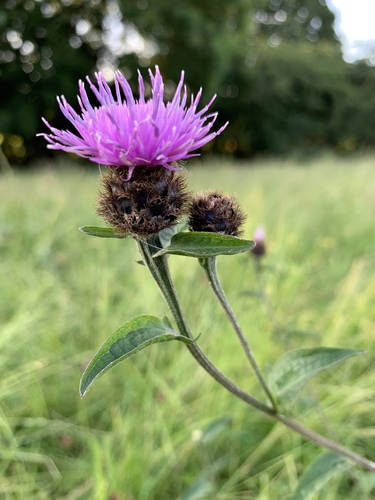
black knapweed
Centaurea nigra
A champion of the summer meadow, black knapweed is a magnet for butterflies and bees. Its vibrant purple 'buttons' and tough, wiry stems make it a resilient and essential centerpiece for any wild backyard.
Quick Identification
Size
Grows to a height of 30–100 cm (12–40 inches) with a spread of approximately 30–60 cm (12–24 inches).
Colors
Vibrant purple to pinkish-purple flower heads; dark brown to black overlapping bracts (scales); dull grayish-green foliage.
Key Features
- Thistle-like purple flower head without spines
- Hard, blackish-brown overlapping scales (bracts) below the petals
- Stiff, wiry, and slightly hairy stems
- Rough, lance-shaped leaves
When You’ll See Them
Geographic range
Where Does the black knapweed Live?
Native to the temperate regions of Europe and the British Isles, black knapweed is a staple of the Old World countryside. It has successfully established itself across much of North America, from the northern United States through southern Canada, and can also be found in parts of Australia and New Zealand. It thrives in various climates but is most at home in the temperate zones where seasonal shifts support its perennial growth cycle.
Basemap © OpenStreetMap contributors
Behavior
Black knapweed is a hardy perennial wildflower that serves as one of nature’s most effective nectar hubs. While it remains stationary, its biological 'behavior' is centered on a prolific blooming cycle from June to September. It is a highly social plant in the ecosystem, often forming dense colonies in meadows that provide a stable platform for a vast array of insects. Unlike thistles which it closely resembles, knapweed is spineless, making it a friendly neighbor in high-traffic garden areas.
The plant is famous for its resilience; its tough, wiry stems allow it to remain upright during heavy summer rains and high winds, ensuring its nectar remains accessible to pollinators. In the autumn, the vibrant purple petals drop away, leaving behind hard, button-like seed heads. These 'hardheads' (a common nickname) stay standing through winter, providing a vital source of seeds for birds and a place for small insects to overwinter.
EverydayEarth exclusive
Camera Tips
Capturing black knapweed on an AI-powered camera requires a shift in strategy from animal tracking to insect observation. Because the plant itself doesn't move (other than swaying in the breeze), the goal is to use the flower as a 'stage' for visiting wildlife. Position your camera on a short tripod or stake at the same height as the flower heads—roughly 2 to 3 feet off the ground. A slight upward angle toward the sky can create a beautiful 'hero shot' of the flower and any butterfly that lands on it.
To avoid thousands of 'false' triggers caused by the stems blowing in the wind, adjust your camera's sensitivity settings to 'Medium' or use a 'Time-Lapse' mode. If your AI camera has a specific 'Insect' or 'Small Animal' detection mode, this is the time to use it. Setting the camera to take a 3-photo burst or a short 10-second video clip when triggered will help you capture the precise moment a bee or butterfly extends its proboscis into the florets.
Lighting is critical for bringing out the rich purple hues of the petals. The 'Golden Hour'—the hour after sunrise or before sunset—provides a soft glow that prevents the colors from looking washed out. However, if your goal is to document pollinator diversity, ensure your camera is active during the peak heat of the day (11 AM to 3 PM), as this is when the widest variety of butterflies and hoverflies are most active on the blooms. In late summer and autumn, keep the camera running to catch goldfinches as they land on the dried seed heads.
Similar Species
Species that look similar or are commonly confused with black knapweed.
Frequently Asked Questions
Record black knapweed at your habitat
Connect a camera to start building your own species record — AI identifies every visitor automatically.