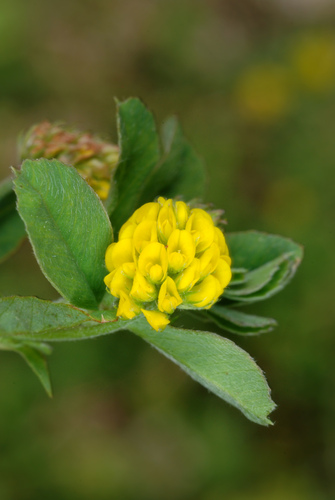
Black Medick
Medicago lupulina
A resilient traveler found in backyards worldwide, Black Medick is a tiny yellow powerhouse that fixes nitrogen in the soil and feeds a hidden world of small pollinators.
Quick Identification
Size
Prostrate stems 15–60 cm (6–24 in) long; flower heads 3–8 mm (0.1–0.3 in) wide
Colors
Bright yellow flower clusters; dark green trifoliate leaves; seed pods turn kidney-bean shaped and distinctively black when mature
Key Features
- Tiny, globe-like yellow flower heads composed of 10-50 florets
- Trifoliate leaves with the center leaflet on a slightly longer stalk
- Leaf tips have a tiny, sharp point (mucronate) extending from the midrib
- Coiled, heavily-veined seed pods that turn charcoal black
- Stems are often hairy and four-angled
When You’ll See Them
Geographic range
Where Does the Black Medick Live?
Native to the temperate regions of Europe, North Africa, and Western Asia, Black Medick has become a cosmopolitan traveler found on nearly every continent. It is now a widespread naturalized species across the United States and Canada, often appearing in urban environments and agricultural fields alike. This resilient plant is equally at home in the Mediterranean basin as it is in the temperate meadows of the United Kingdom and the temperate zones of East Asia.
Basemap © OpenStreetMap contributors
Behavior
Black Medick is a versatile legume that functions as either an annual or a short-lived perennial. It is highly valued in natural ecosystems for its nitrogen-fixing capabilities; through a symbiotic relationship with soil bacteria, it pulls nitrogen from the air and enriches the surrounding soil. This makes it a pioneer species, often the first to colonize poor or disturbed ground where other plants might struggle to survive.
In a backyard setting, Black Medick is often seen as a lawn weed, but it serves a vital role as a nectar source for small pollinators. It grows low to the ground, spreading its stems in a prostrate mat that can tolerate heavy foot traffic and frequent mowing. While it doesn't 'behave' in the animal sense, it exhibits phototropism, with its leaves and flowers tracking the sun to maximize energy intake. It is also an opportunistic grower, blooming from spring until the first hard frost.
EverydayEarth exclusive
Camera Tips
Capturing Black Medick on a backyard camera requires a focus on macro photography and time-lapse settings rather than motion triggers. Because the plant is low-growing, place your camera on a ground-level tripod or a specialized spike mount. Angle the lens downward at a 45-degree angle to capture both the trifoliate leaf structure and the tiny yellow flower heads. Since these flowers are very small (often less than 5mm), use a camera with a short focal distance or a macro lens attachment to prevent blurring.
For the best results, set your camera to take time-lapse photos during the peak of summer. A frequency of one photo every 15 minutes from sunrise to sunset can reveal the plant's 'sleep movements,' where leaflets fold together at night and reopen to follow the sun during the day. This is a fascinating behavior often missed by the naked eye. Bright, overcast days are better than direct harsh sunlight, as the yellow flowers can easily 'blow out' and lose detail in high-contrast conditions.
If your AI camera is set to detect movement, you can use Black Medick as a 'pollinator stage.' The plant is a magnet for small sweat bees, hoverflies, and the Common Blue butterfly (which uses it as a host plant). Position the camera about 12 inches away from a healthy patch of blooms. High-speed shutter settings are essential here to freeze the motion of the tiny insects that visit these micro-flowers. In late summer, keep the camera active to document the color change of the seed pods from green to their namesake black.
Similar Species
Species that look similar or are commonly confused with Black Medick.
Frequently Asked Questions
Record Black Medick at your habitat
Connect a camera to start building your own species record — AI identifies every visitor automatically.