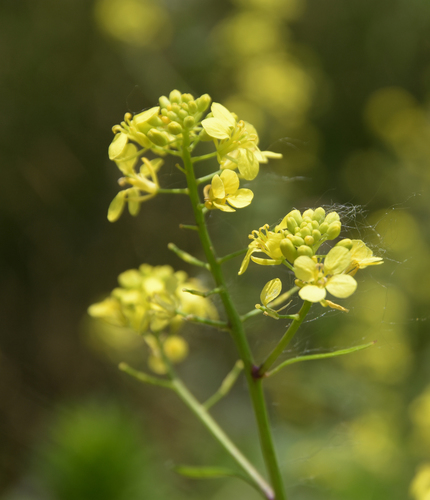
Black Mustard
Mutarda nigra
A towering spire of golden blooms, Black Mustard is a vibrant addition to the landscape that serves as a vital nectar station for local pollinators.
Quick Identification
Size
Grows 0.6–2.4 meters (2–8 feet) tall; individual flowers are approximately 8 mm (0.3 inches) wide.
Colors
Brilliant yellow petals; vibrant green stems and foliage; dark brown to black seeds.
Key Features
- Bright yellow four-petaled flowers in clusters
- Seed pods (siliques) held closely parallel to the stem
- Lower stems often covered in stiff, bristly hairs
- Towering height, often exceeding 6 feet in ideal conditions
When You’ll See Them
Geographic range
Where Does the Black Mustard Live?
Native to the cooler regions of North Africa, temperate Europe, and parts of Asia, Black Mustard has successfully traveled the globe as both a crop and a hardy pioneer species. It is now widely naturalized across North America, where it thrives in almost every state in the U.S. and throughout southern Canada. Its ability to adapt to various soil types has allowed it to establish dense populations in Mediterranean climates and temperate grasslands alike.
Basemap © OpenStreetMap contributors
Behavior
Black Mustard is a hardy and fast-growing annual plant that is often one of the first to colonize disturbed soils. It follows a rapid life cycle, germinating in early spring and quickly sending up tall, branching stalks to reach for the sunlight. This growth strategy allows it to overshadow smaller competitors, making it a dominant presence in meadows and along roadsides.
During its blooming period, the plant becomes a hub of biological activity. Its nectar-rich flowers attract a wide variety of pollinators, from honeybees and bumblebees to butterflies and hoverflies. As the flowers fade, the plant produces slender pods filled with pungent seeds that have been harvested by humans for thousands of years for use as a spice and a medicinal rub.
EverydayEarth exclusive
Camera Tips
When photographing Black Mustard, your AI-powered camera should be positioned to take advantage of the plant's height. Set your camera at chest height (about 3-4 feet) to capture the dense flowering tops where the most action occurs. Because this species attracts a high volume of pollinators, using a camera with a fast trigger speed or high-frame-rate video will help you capture the quick movements of visiting bees and butterflies.
Since Black Mustard is a tall, slender plant, it is prone to swaying in the wind. To avoid blurry images, try to place your camera in a spot with some wind protection, or use a high shutter speed setting if your camera allows manual overrides. For the best lighting, face your camera away from the sun (North or South) to ensure the bright yellow petals don't become 'blown out' or overexposed in the midday glare.
If you are interested in documenting the plant's growth, use a time-lapse setting. Black Mustard grows incredibly fast—sometimes several inches in a week—making it a perfect subject for a month-long time-lapse project. You don't need any artificial bait for this species; the nectar in the yellow blooms is the only lure you’ll need to attract a parade of backyard insects.
Similar Species
Species that look similar or are commonly confused with Black Mustard.
Frequently Asked Questions
Record Black Mustard at your habitat
Connect a camera to start building your own species record — AI identifies every visitor automatically.