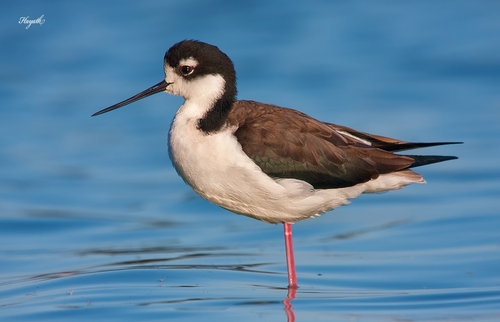
Black-necked Stilt
Himantopus mexicanus
With legs that seem to go on forever and a striking tuxedo plumage, the Black-necked Stilt is the supermodel of the marshlands.
Quick Identification
Size
Length: 35-40 cm (14-16 in); Wingspan: 71-75 cm (28-30 in); Weight: 136-220 g (4.8-7.8 oz)
Colors
Jet black wings and back with snowy white underparts; males have a greenish gloss on the black feathers while females have a more brownish tinge. Legs are vibrant bubblegum pink.
Key Features
- Extraordinarily long, thin pink legs
- Sharp tuxedo-like black and white plumage
- Fine, needle-like black bill
- White spot above the eye and white tail
When You’ll See Them
Sightings on EverydayEarth
Apr 13, 2026
A diverse group of waterfowl and shorebirds is active in a shallow marsh channel. American Coots and various ducks, including Northern Shovelers and Pintails, swim and forage in the water. Black-necked Stilts wade through the shallows, while a Great Egret stands watch in the distance. Occasionally, groups of birds take flight across the frame, showcasing the high level of activity in the wetland.
Apr 7, 2026
A vibrant wetland scene teeming with avian activity. A Great Egret stands watchfully on the far grassy bank. In the foreground, several American Coots swim calmly, while a Black-necked Stilt forages along the muddy shoreline on the left. Various other waterfowl are scattered across the water, swimming and diving among the reeds.
Mar 31, 2026
A peaceful early morning scene at the refuge shows several bird species sharing a shallow marsh. In the foreground, a White-faced Ibis preens its feathers near the reeds while a Greater Yellowlegs forages actively in the center. To the right, a Black-necked Stilt stands on its exceptionally long legs. In the background, a Northern Pintail swims across the calm water as the morning sun illuminates the dry vegetation.
Geographic range
Where Does the Black-necked Stilt Live?
Native to the Western Hemisphere, the Black-necked Stilt claims a massive range stretching from the coastal and interior western United States down through Central America and the Caribbean, reaching as far south as Brazil and Peru. In North America, they are iconic residents of the California coast, the Great Basin, and the Gulf Coast through Florida. While tropical populations remain year-round residents, birds from the northern interior are migratory, flying south to Mexico and the southern United States to escape the winter freeze.
Basemap © OpenStreetMap contributors
Behavior
Black-necked Stilts are among the most vocal and animated shorebirds in the Americas. They are famous for their high-pitched, repetitive "yip-yip-yip" calls which they use to signal alarm or defend their territory. When a predator or intruder approaches their nesting site, stilts often perform a "popcorn display," where multiple birds jump and flap their wings to distract the threat. They are social birds, often seen in small groups, but they maintain strict personal space while foraging.
Feeding is a highly visual and precise activity for these birds. They spend most of their day wading through shallow water, using their long legs to access depths that other shorebirds cannot reach. They typically pick prey from the surface or just beneath the water with surgical accuracy. While they are generally cautious around humans, they are frequent visitors to man-made wetlands, such as salt evaporation ponds and rice fields, where they have become accustomed to nearby human activity.
EverydayEarth exclusive
Camera Tips
To capture the perfect shot of a Black-necked Stilt, placement is everything. These birds prefer the "edge zone"—the precise transition between mudflats and shallow water. Set your AI-powered camera on a tripod or a low mount just 6-12 inches above the ground. This low-angle perspective highlights their impossibly long legs and provides a beautiful reflection on the water's surface, which is a hallmark of high-quality shorebird photography.
Because stilts are highly sensitive to movement, ensure your camera is well-camouflaged or tucked into shoreline vegetation. Avoid using a traditional flash at night as it may startle them; instead, rely on the high-sensitivity sensors of modern AI cameras during the golden hours of dawn and dusk when stilts are most active. If you are monitoring a backyard pond, keep the water level shallow (under 4 inches) to encourage them to stop and forage in front of your lens.
For camera settings, prioritize a fast shutter speed or a high-sensitivity motion trigger. Stilts are fast movers; they often perform sudden "bobbing" motions or quick dashes when chasing insects. A trigger speed of 0.2 seconds or faster is ideal to catch them mid-stride. In the spring, keep an eye out for nesting behavior; if you see a stilt acting distressed or loud, move your camera back, as they are very protective of their ground nests and you don't want to cause them unnecessary stress.
Similar Species
Species that look similar or are commonly confused with Black-necked Stilt.
Frequently Asked Questions
Record Black-necked Stilt at your habitat
Connect a camera to start building your own species record — AI identifies every visitor automatically.