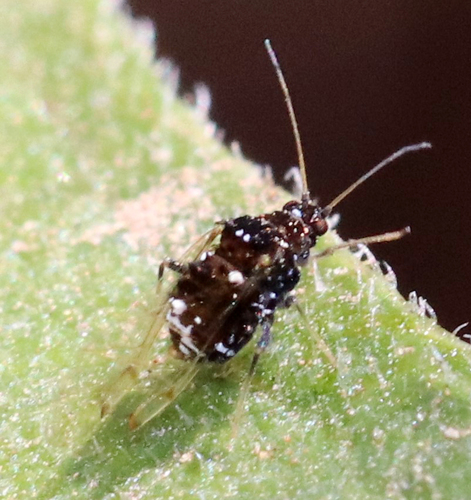
Black Pecan Aphid
Melanocallis caryaefoliae
A tiny insect with a big impact, the Black Pecan Aphid is a master of the pecan canopy. Known for its distinctive black bumps and the striking yellow patterns it leaves on foliage, this miniature marvel offers a fascinating glimpse into the complex world of plant-insect interactions.
Quick Identification
Size
Approximately 1.5 to 2.0 mm (0.06 to 0.08 inches) in length
Colors
Adults are charcoal black to dark olive-green; nymphs are often a lighter olive-gray with prominent black bumps
Key Features
- Distinctive black tubercles (bumps) along the back
- Creates bright yellow, rectangular spots on leaves between veins
- Solitary feeding habit on the underside of foliage
- Clear wings with dark, prominent venation in winged adults
When You’ll See Them
Geographic range
Where Does the Black Pecan Aphid Live?
The Black Pecan Aphid is native to North America, closely following the natural distribution of the pecan tree throughout the Southern United States and Northern Mexico. It is most prevalent in the 'Pecan Belt,' stretching from Texas and Oklahoma eastward to Georgia and South Carolina. Beyond its native range, this resilient insect has successfully hitched a ride on exported trees to become an established pest in South Africa, South America—particularly Brazil and Argentina—and Mediterranean regions like Italy and Israel.
Basemap © OpenStreetMap contributors
Behavior
The Black Pecan Aphid is a specialized feeder that exhibits more solitary and active behavior than most other aphid species. Instead of forming dense, stationary clusters, these aphids tend to disperse across the underside of mature pecan leaves, often preferring the shaded interior of the tree's canopy. They are remarkably sensitive to movement; if they sense a predator or a significant disturbance, they are known to quickly walk away or even drop from the leaf to escape.
What makes their behavior truly unique is the physiological impact they have on their host. As they feed on the tree's sap, they inject a toxic saliva that interferes with the leaf's chlorophyll. This results in the formation of dead, rectangular spots of tissue. Unlike the 'honeydew' specialists that leave leaves sticky, the Black Pecan Aphid is primarily noticed for the dramatic yellowing and premature leaf drop it causes in late summer, which can significantly impact the tree's ability to produce nuts.
EverydayEarth exclusive
Camera Tips
To capture the Black Pecan Aphid on camera, you must move beyond standard trail cam setups and utilize macro photography equipment. Because these insects are only a few millimeters long, an AI-powered camera with a dedicated macro lens or a high-resolution digital microscope attachment is essential. Position your camera specifically on the underside of older, established pecan leaves rather than new growth, as this species prefers the nutrient-rich, mature foliage found in the lower and inner sections of the tree canopy.
Stability is your biggest challenge. Even a light breeze can move a leaf out of the razor-thin focus range of a macro lens. Use a flexible arm clamp (often called a 'Plamp') to hold the specific leaf still while the camera is mounted on a sturdy tripod. For the best results, set your camera to a time-lapse mode with intervals of 2 to 5 minutes. This allows you to witness the 'yellowing' effect in real-time as the aphid feeds, a process that can cause visible tissue change over just a few days.
Lighting is critical for highlighting the aphid's dark, shiny body. Use a diffused LED side-light to bring out the texture of the black tubercles on their backs without creating a 'white-out' glare on the leaf surface. If you are looking for action shots, keep an eye out for ladybugs or lacewing larvae; these predators are often found in the same areas, and capturing a predator-prey interaction provides some of the most compelling backyard wildlife footage available at the microscopic level.
Similar Species
Species that look similar or are commonly confused with Black Pecan Aphid.
Frequently Asked Questions
Record Black Pecan Aphid at your habitat
Connect a camera to start building your own species record — AI identifies every visitor automatically.