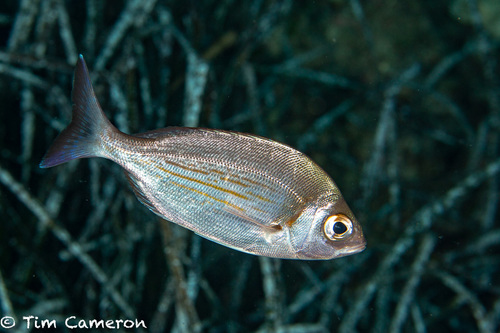
Black Seabream
Spondyliosoma cantharus
A silver-scaled wonder of the Atlantic and Mediterranean, the Black Seabream is famous for its unique nesting habits and its ability to change color and gender throughout its life.
Quick Identification
Size
Typically 30-40 cm (12-16 in), reaching a maximum length of 60 cm (24 in) and weighing up to 1.2 kg (2.6 lbs).
Colors
Silvery-grey to bluish body with faint golden longitudinal stripes; breeding males develop a darker, almost black coloration with a bright blue band between the eyes.
Key Features
- Deep, oval-shaped body compressed laterally
- Small mouth with rows of sharp, pointed teeth
- Single continuous dorsal fin with sharp spines
- 6-7 faint dark vertical bars often visible in younger individuals
When You’ll See Them
Geographic range
Where Does the Black Seabream Live?
The Black Seabream is native to the temperate and subtropical waters of the Eastern Atlantic Ocean, stretching from the cold reaches of Norway and the British Isles down to the southern tip of Africa. It is a common sight throughout the Mediterranean and can also be found in the Black Sea, making it one of the most widely distributed members of the Sparidae family. While they are most abundant in European coastal waters, their presence extends across several climate zones, adapting to both rocky reefs and sandy shelf environments.
Basemap © OpenStreetMap contributors
Behavior
The Black Seabream is a fascinating social fish known for its complex reproductive cycle. They are protogynous hermaphrodites, meaning they begin their lives as females and can later transition into males as they grow larger and older. During the spawning season, their social structure shifts dramatically as males become highly territorial, abandoning their usual schooling behavior to focus on nesting.
Unlike many marine fish that scatter eggs into the open water, the Black Seabream is a nest-builder. The male uses his tail to clear a circular depression in the sandy or gravelly seafloor, exposing a hard surface for the female to deposit her eggs. He then guards the nest fiercely against predators until the fry hatch. Outside of the breeding season, they are generally peaceful and can be seen foraging in small groups along coastal reefs.
EverydayEarth exclusive
Camera Tips
To capture the Black Seabream on an underwater camera, focus on transition zones where rocky reefs meet sandy seafloors. During the spring spawning season, look for males in shallower water (5-15 meters) as they meticulously clear circular nests in the sand; placing a camera on a tripod nearby can provide an incredible look at this rare parental behavior in fish. Ensure your housing is rated for the depth and use a wide-angle lens to capture their schooling behavior.
Baiting is highly effective for drawing Black Seabream into the frame. Use a perforated container or mesh bag filled with crushed mussels, crabs, or chopped mackerel. Secure the bait approximately two feet in front of the lens to ensure the fish remain in focus. Because they are cautious, it is often best to leave the camera 'soaking' for several hours, allowing the scent to disperse and the fish to grow comfortable with the equipment's presence.
Timing is crucial for the best lighting and activity. These fish are most active during daylight hours, particularly during the rising tide when nutrients are being pushed toward the shore. In clearer Atlantic or Mediterranean waters, aim for mid-morning when the sun is high enough to penetrate the depths without creating heavy shadows. If you are using an AI-powered trigger, set it to high sensitivity, as their quick, darting movements can be missed by slower sensors. Adjust your white balance to 'underwater' or 'cloudy' to compensate for the blue-green tint of the water and bring out the subtle golden stripes on their scales.
Similar Species
Species that look similar or are commonly confused with Black Seabream.
Frequently Asked Questions
Record Black Seabream at your habitat
Connect a camera to start building your own species record — AI identifies every visitor automatically.