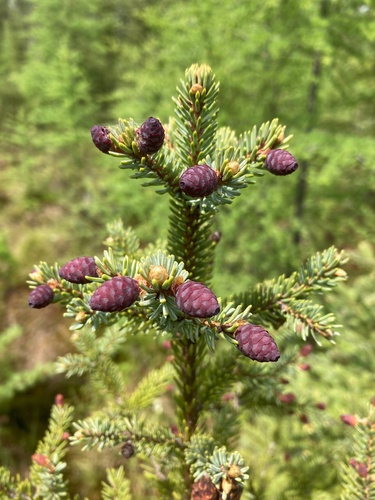
black spruce
Picea mariana
The resilient sentinel of the north, the Black Spruce thrives where other trees fail, anchoring the vast boreal ecosystems of Alaska and Canada. Its narrow, dark spires are a hallmark of the wilderness, providing essential shelter and food for a diverse array of cold-hardy wildlife.
Quick Identification
Size
Height: 5–15 m (15–50 ft), though can reach 30 m (100 ft) in optimal conditions; Trunk diameter: 15–50 cm (6–20 in)
Colors
Dull blue-green needles; grey-brown scaly bark; dark purple to blackish cones that mature to a dark brown
Key Features
- Short, stiff four-sided needles (6-15mm)
- Small, rounded, dark purple cones clustered at the top
- Narrow, spire-like crown with drooping lower branches
- Twigs covered in fine, reddish-brown hairs
When You’ll See Them
Geographic range
Where Does the black spruce Live?
The black spruce is a quintessential inhabitant of the North American continent, stretching in a massive, continuous band from the interior of Alaska across all ten Canadian provinces and three territories. In the United States, its range dips southward into the Great Lakes region—specifically Minnesota, Wisconsin, and Michigan—as well as the high-elevation bogs of the Northeast, including Maine and New York. This hardy conifer thrives in the challenging conditions of the taiga, marking the northernmost limit of the tree line in many regions.
Basemap © OpenStreetMap contributors
Behavior
The black spruce is a slow-growing, long-lived conifer that defines the rugged character of the northern wilderness. Unlike many other trees, it is remarkably well-adapted to poor, acidic soils and waterlogged conditions, often forming dense, 'scraggy' stands in peatlands and bogs. One of its most fascinating biological traits is 'layering,' where the lower branches touch the ground and eventually grow their own roots, creating a circle of smaller clone trees around the parent trunk.
Ecologically, the black spruce is a fire-dependent species. While its thin bark makes it susceptible to being killed by forest fires, it has evolved semi-serotinous cones. These cones remain on the tree for years and are triggered to open and release their seeds by the heat of a fire, ensuring the next generation of spruce can dominate the nutrient-rich ash left behind. In the context of human interaction, it is a vital resource for the pulp and paper industry and serves as the iconic 'Christmas tree' of the far north.
EverydayEarth exclusive
Camera Tips
Capturing the black spruce on a trail camera is less about catching the tree in motion and more about using it as a hub for wildlife activity. Because these trees provide dense cover and a consistent food source (seeds), they are magnets for boreal species. Mount your camera on a nearby sturdy trunk facing a cluster of spruce cones. This is the best way to record the behavior of Red Squirrels, Crossbills, and Pine Grosbeaks as they work to extract seeds from the tight scales.
For a unique perspective, set your camera to time-lapse mode during the winter months. Black spruces are famous for their 'snow-loading'—the way their narrow, flexible branches shed heavy snow to prevent breakage. A time-lapse over 24-48 hours during a snowstorm can capture the incredible structural resilience of the tree. If you are in a boggy area, position the camera 2-3 feet off the ground facing a black spruce 'thicket' to capture elusive mammals like the Canada Lynx or Snowshoe Hare that use the low-hanging branches for camouflage.
If you are looking for aesthetic shots, the best time of day is the 'golden hour' just before sunset. The low-angle light catches the fine hairs on the twigs and the deep purple hue of the young cones, which can look almost black in standard midday light. Ensure your camera's white balance is set correctly, as the blue-green needles can sometimes appear overly grey in flat lighting. In the spring, look for the tiny, bright red female flowers at the very tips of the upper branches—they are a rare and beautiful sight if you can get a high-angle camera placement.
Similar Species
Species that look similar or are commonly confused with black spruce.
White Spruce
White spruce has longer, more cylindrical cones and hairless twigs, and it typically prefers better-drained, richer soils than the black spruce.
Red Spruce
Red spruce has shiny yellow-green needles and larger, orange-brown cones, and its range is generally restricted to the northeastern US and maritime Canada.
Tamarack
Often found in the same bogs, the Tamarack is a deciduous conifer that turns bright gold and drops its needles in the fall, whereas the black spruce stays green year-round.
Frequently Asked Questions
Record black spruce at your habitat
Connect a camera to start building your own species record — AI identifies every visitor automatically.