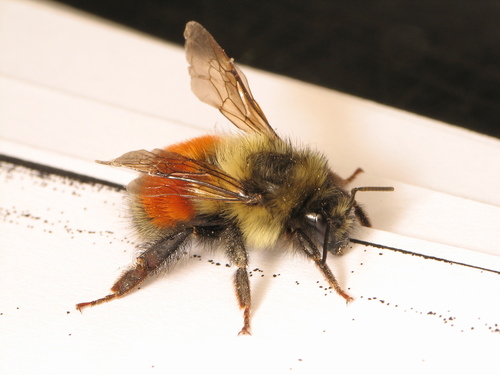
Black-tailed Bumble Bee
Bombus melanopygus
One of the first messengers of spring, the Black-tailed Bumble Bee is a hardy and colorful pollinator. Easily recognized by its vibrant orange mid-section, this busy bee is a vital guest in any Western backyard garden.
Quick Identification
Size
Queens: 15–18 mm (0.6–0.7 in); Workers/Males: 10–13 mm (0.4–0.5 in); Wingspan: 25–32 mm
Colors
Thorax is mostly yellow with a black band; abdomen features a distinctive orange-red band on the 2nd and 3rd segments, with a black tip.
Key Features
- Bright orange-red hair on abdominal segments 2 and 3
- Black hair at the tip of the abdomen (the 'black tail')
- Dense yellow hair on the face and front of the thorax
- Early-season emergence, often seen while snow is still on the ground
When You’ll See Them
Geographic range
Where Does the Black-tailed Bumble Bee Live?
Native to the western regions of North America, the Black-tailed Bumble Bee enjoys a massive geographic footprint. Its territory begins in the Aleutian Islands and extends through Alaska and Western Canada, moving south through the Pacific Northwest into California and the northern reaches of Mexico. It is a common inhabitant of the Rocky Mountains, found in high-altitude meadows as frequently as it is found in coastal backyard gardens.
Basemap © OpenStreetMap contributors
Behavior
The Black-tailed Bumble Bee is a highly active, social insect known for its remarkable resilience to cold. As one of the earliest bumble bees to emerge in the spring, the queens are often spotted in late winter searching for nesting sites, typically in abandoned rodent burrows or thick tufts of grass. Once a colony is established, the smaller workers take over the foraging duties, moving with a characteristic frantic buzz from flower to flower.
These bees are 'buzz pollinators,' meaning they use their powerful flight muscles to vibrate flowers at specific frequencies to release stubborn pollen. This makes them exceptionally effective at pollinating plants like tomatoes and blueberries. They are generally non-aggressive toward humans, only stinging if their nest is directly threatened, and are a welcome sight for gardeners looking to boost their fruit and vegetable yields.
EverydayEarth exclusive
Camera Tips
To capture high-quality footage of the Black-tailed Bumble Bee, focal distance is your most important setting. Because these bees are small and move quickly, place your AI camera within 12 to 18 inches of 'high-traffic' flowers. Look for early-season bloomers like Oregon Grape, Willows, or Rosemary, which attract queens early in the year. A camera with a dedicated macro lens or a close-focusing 'bird feeder' style setup works best to capture the fine orange hairs on their abdomen.
Since bumble bees are most active when the sun is out, ensure your camera is positioned so the sun is behind the lens. This prevents the bee from being silhouetted and allows the AI to clearly identify the color patterns on its back. High-speed video modes (60fps or higher) are ideal, as they allow you to slow down the footage to see the bee’s intricate wing movements and 'pollen baskets' (corbiculae) on their hind legs when they are full.
If you are using a trigger-based camera, set the sensitivity to 'High' and the burst mode to at least 3-5 photos. Bumble bees spend only a few seconds on each flower, so a fast trigger speed is essential. To encourage them to linger longer in front of your lens, plant tubular flowers like Foxgloves or Penstemons, which require the bee to crawl partially inside, giving your camera more time to lock focus and capture the perfect shot.
Similar Species
Species that look similar or are commonly confused with Black-tailed Bumble Bee.
Hunt's Bumble Bee
Very similar orange bands, but Hunt's has yellow hair at the tip of the abdomen instead of black.
Tricolored Bumble Bee
Found more in the East and North; features a more prominent yellow 'W' shape on the thorax.
Red-belted Bumble Bee
The orange/red band is usually narrower and the hair is much shorter and more 'cropped' looking.
Frequently Asked Questions
Record Black-tailed Bumble Bee at your habitat
Connect a camera to start building your own species record — AI identifies every visitor automatically.