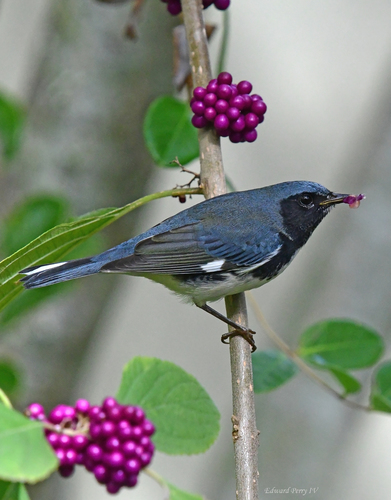
Black-throated Blue Warbler
Setophaga caerulescens
A striking icon of the deep eastern woods, the Black-throated Blue Warbler stands out with its dapper three-toned suit and surprisingly bold personality. This tiny migrant is a favorite for photographers and backyard observers who enjoy its methodical pace and distinctive buzzy song.
Quick Identification
Size
Length: 13 cm (5.1 in); Wingspan: 19-20 cm (7.5-7.9 in); Weight: 9-11 g (0.32-0.39 oz)
Colors
Males: Slate blue upperparts, jet-black face and throat, white belly. Females: Olive-brown upperparts, pale yellowish underparts, small white wing patch.
Key Features
- Jet-black face and throat (males)
- Deep slate-blue upperparts (males)
- Small white 'handkerchief' spot on the wing (both sexes, but prominent in females)
- Pale line over the eye (females)
When You’ll See Them
Geographic range
Where Does the Black-throated Blue Warbler Live?
Native to the eastern half of North America, the Black-throated Blue Warbler breeds primarily in the deep forests of southeastern Canada, the Great Lakes region, and down the spine of the Appalachian Mountains. As a neotropical migrant, it travels south for the winter to settle in the Greater Antilles, including Cuba and Jamaica, as well as parts of Central America. While they are a staple of the eastern woods, they are rarely seen in the western United States except as occasional vagrants.
Basemap © OpenStreetMap contributors
Behavior
Black-throated Blue Warblers are known for their relatively calm and methodical foraging style compared to other high-energy warblers. They spend much of their time in the lower and middle stories of the forest, hopping along branches and peering under leaves to find caterpillars and spiders. They are famously 'tame' birds, often allowing humans to approach quite closely before they flutter away to the next bush.
During the breeding season, males are highly territorial and can be heard singing their buzzy, ascending 'zee-zee-zee-zeee' song from consistent perches. In the winter, they migrate to the Caribbean where they often hold individual territories even in their wintering grounds, though they may occasionally join mixed-species foraging flocks to increase their chances of finding food.
EverydayEarth exclusive
Camera Tips
To capture the best footage of Black-throated Blue Warblers, focus your camera efforts on the 'understory'—the layer of vegetation between the ground and the lower tree canopy. Position your camera on a tripod or mount it to a tree at a height of 3 to 5 feet. Because these birds prefer deep, shady woods, ensure your camera is set to a high sensitivity (ISO) or use a model with excellent low-light performance to avoid losing detail in the dark blues and blacks of the male's plumage.
The absolute best way to draw these birds into camera range is with a moving water feature. A birdbath with a solar-powered dripper or a small circulating fountain is a magnet for warblers during their spring and fall migrations. Place the camera about 3 to 5 feet away from the water source, keeping the lens at eye level with the birds. This angle provides an intimate view of their bathing behavior and clearly captures the diagnostic white wing spots.
During the breeding season in May and June, look for areas with dense thickets of mountain laurel or rhododendron. If you are using a trail camera, set it to 'Photo + Video' mode with a short trigger interval. These birds move more slowly than other warblers, but they are still small and quick; a high-speed trigger is essential to ensure you don't just catch a tail feather as they fly out of the frame.
Similar Species
Species that look similar or are commonly confused with Black-throated Blue Warbler.
Frequently Asked Questions
Record Black-throated Blue Warbler at your habitat
Connect a camera to start building your own species record — AI identifies every visitor automatically.