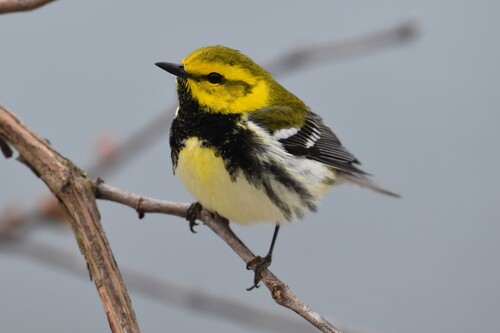
Black-throated Green Warbler
Setophaga virens
With its buzzy song and brilliant yellow face, the Black-throated Green Warbler is a jewel of the coniferous forest. This tireless traveler migrates thousands of miles annually, bringing a flash of gold to backyards across North America.
Quick Identification
Size
11–13 cm (4.3–5.1 in) long; wingspan of 17–20 cm (6.7–7.9 in); weight 8–11 g (0.28–0.39 oz)
Colors
Olive-green back, bright yellow face, and white underparts with dark flank streaking. Males feature a solid black throat and upper breast; females have a pale or mottled throat.
Key Features
- Striking black throat and upper breast
- Bright yellow cheeks and face
- Two white wing bars on dark wings
- Olive-green crown and back
- Constant, buzzy 'zee-zee-zee-zoo-zee' song
When You’ll See Them
Geographic range
Where Does the Black-throated Green Warbler Live?
This resilient traveler is native to North America, breeding extensively across the boreal forests of Canada and the northeastern United States, stretching down the Appalachian Mountains. As a long-distance migrant, the Black-throated Green Warbler spends its winters in the lush tropical forests of Mexico, Central America, and parts of the Caribbean. They are a common sight during spring and fall migration throughout the eastern half of the United States and along the Gulf Coast.
Basemap © OpenStreetMap contributors
Behavior
The Black-throated Green Warbler is a high-energy songbird known for its restless nature. It rarely stays still for more than a second, constantly flitting through the outer branches of the forest canopy in search of food. During the breeding season, males are persistent singers, often heard before they are seen, delivering their buzzy, rhythmic songs from high perches to defend territory or attract a mate.
These birds are primarily solitary during the breeding months but often join mixed-species foraging flocks during migration and on their wintering grounds. They exhibit a unique foraging behavior called 'hover-gleaning,' where they momentarily pause in mid-air to pluck insects from the underside of leaves or from the tips of coniferous needles. While they are not particularly shy around humans, their preference for the high canopy makes them a 'neck-straining' species for birdwatchers.
EverydayEarth exclusive
Camera Tips
Capturing a Black-throated Green Warbler on camera is a rewarding challenge because they spend much of their time high in the canopy. To increase your chances, position your AI camera near a water source like a birdbath or a moving water feature. These warblers are highly attracted to the sound of dripping or splashing water, especially during migration when they descend from the treetops to hydrate and bathe.
Set your camera at a height of 3 to 5 feet, angled slightly downward toward the water source. Since these birds are incredibly fast-moving, use a high shutter speed or a 'burst' photo mode if your device allows it. The best time for capture is early morning, within two hours of sunrise, when their activity levels and singing are at their peak. Natural morning light also helps highlight the subtle olive and yellow tones of their plumage.
If you have coniferous trees like hemlock or spruce in your yard, consider placing a camera on a branch that has good light exposure. While they don't typically visit traditional seed feeders, they may occasionally investigate suet or mealworm feeders during particularly cold spells in early spring. For the best results, ensure your camera is positioned to capture the bird's side profile, which highlights the diagnostic black throat and yellow face that the AI uses for identification.
Similar Species
Species that look similar or are commonly confused with Black-throated Green Warbler.
Townsend's Warbler
Townsend's has a dark ear patch and more extensive yellow on the breast, whereas the Black-throated Green has a clear yellow face and white belly.
Hermit Warbler
The Hermit Warbler has a completely yellow head without the olive-green crown and back seen on the Black-throated Green.
Golden-cheeked Warbler
This rare species has a black line through the eye, which the Black-throated Green Warbler lacks.
Frequently Asked Questions
Record Black-throated Green Warbler at your habitat
Connect a camera to start building your own species record — AI identifies every visitor automatically.