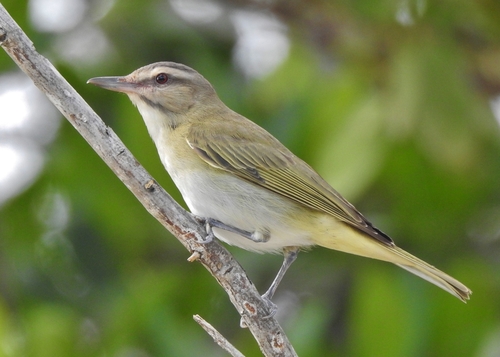
Black-whiskered Vireo
Vireo altiloquus
A persistent singer of the tropical coast, the Black-whiskered Vireo is the quintessential 'voice of the mangroves.' Distinguished by its subtle dark mustache and piercing red eyes, this Caribbean traveler is a master of camouflage in the coastal canopy.
Quick Identification
Size
14–16 cm (5.5–6.3 in) long; wingspan of 23–26 cm (9–10 in); weighs 15–20 g (0.5–0.7 oz)
Colors
Olive-green upperparts, dull white underparts, grey crown, and a distinctive black 'whisker' stripe on the throat
Key Features
- Fine black malar stripe (the 'whisker')
- Red iris in adults
- Grey cap with a bold white eyebrow stripe
- Heavy, slightly hooked bill
When You’ll See Them
Geographic range
Where Does the Black-whiskered Vireo Live?
Native to the Caribbean basin and the tropical fringes of the southeastern United States, the Black-whiskered Vireo is a signature species of the West Indies. Its core range extends from the Florida Keys and coastal southern Florida through the Bahamas, Cuba, Hispaniola, Jamaica, and the Lesser Antilles. While Caribbean populations are often year-round residents, those breeding in Florida are migratory, traveling to the Amazon basin and northern South America for the winter months.
Basemap © OpenStreetMap contributors
Behavior
The Black-whiskered Vireo is renowned for being a tireless vocalizer, often singing through the hottest parts of the day when other birds have gone silent. They possess a deliberate foraging style, hopping slowly through the canopy and pausing to peer under leaves for hidden caterpillars. While they are not overly shy, their plumage blends perfectly with tropical foliage, making them much easier to hear than to see.
During the breeding season, they are highly territorial and will vigorously defend their nesting sites in mangroves or coastal hammocks. Unlike many songbirds that flee at the sight of humans, these vireos may continue their repetitive, conversational song even as you stand directly beneath their perch. They are largely solitary outside of the breeding season, though they may join mixed-species foraging flocks during migration.
EverydayEarth exclusive
Camera Tips
Capturing the Black-whiskered Vireo on camera requires a strategic approach because they spend the majority of their time in the mid-to-upper canopy. To get them within range of a backyard AI camera, focus on 'staging' areas rather than the high branches. If you have a bird bath or a water feature, place your camera at a distance of 4-6 feet, angled slightly upward. These birds are frequent bathers, especially in the humid coastal environments they call home.
During the late summer and early fall, these vireos shift their diet toward berries to fuel their migration. If you have native fruiting trees like Seagrape, Gumbo Limbo, or Strangler Fig, position your camera near the ripe fruit clusters. Use a high-sensitivity trigger setting, as vireos move with a slow, methodical pace that can sometimes fail to trip less sensitive sensors. Setting your camera to record 15-20 second video clips is highly recommended over still photos; this increases your chances of seeing the 'whisker' stripe as the bird turns its head.
Lighting is crucial for this species. Because they are often backlit by the bright tropical sky, try to position your camera with the sun at its back to illuminate the subtle grey crown and red eye. If your camera allows for it, a slightly faster shutter speed will help capture their quick 'hover-gleaning' behavior where they snatch insects off the undersides of leaves. Peak activity for your camera will be in the early morning, but don't turn it off at noon—these birds are one of the few species that remain active and visible during the midday heat.
Similar Species
Species that look similar or are commonly confused with Black-whiskered Vireo.
Frequently Asked Questions
Record Black-whiskered Vireo at your habitat
Connect a camera to start building your own species record — AI identifies every visitor automatically.