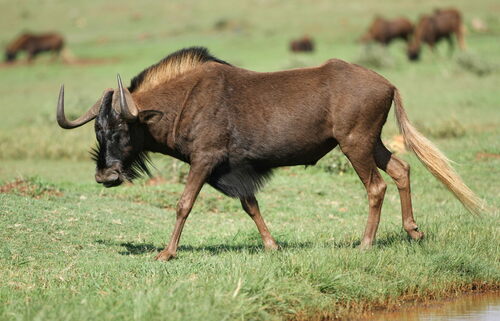
Black Wildebeest
Connochaetes gnou
Often called the 'clown of the plains,' the Black Wildebeest is a spirited icon of the South African highveld, easily recognized by its bright white tail and eccentric, energetic personality.
Quick Identification
Size
Head-and-body length 1.7–2.2 m (5.6–7.2 ft); weight 110–180 kg (240–400 lb)
Colors
Deep chocolate brown to black coat; distinctive long white tail; dark mane and beard
Key Features
- Distinctive long white horse-like tail
- Forward and downward curving horns
- Dark shaggy hair on the muzzle and chest
- Sloping back with a high shoulder hump
When You’ll See Them
Geographic range
Where Does the Black Wildebeest Live?
Native to the southern tip of the African continent, the Black Wildebeest is a quintessential species of the South African highveld. Its core range is centered within the temperate grasslands of South Africa, Lesotho, and Eswatini, where it thrives in open, treeless landscapes. While the species was once hunted nearly to extinction, successful reintroduction programs have established thriving populations in private reserves across Namibia and even small, managed populations in Kenya.
Basemap © OpenStreetMap contributors
Behavior
The Black Wildebeest is a highly social and territorial species, often seen in three distinct social groups: female herds containing adults and young, bachelor herds of young males, and solitary territorial bulls. These animals are famously energetic, often engaging in 'playful' displays that include running in circles, tossing their heads, and jumping—a behavior that earned them the nickname 'the clown of the plains.' Despite this whimsical reputation, territorial bulls are fiercely protective of their patches, using loud, metallic 'gnou' snorts to signal their presence.
Unlike their more famous Blue Wildebeest cousins who participate in massive trans-continental migrations, the Black Wildebeest is generally more sedentary, moving only seasonally within a localized range to find better grazing. They are exclusively diurnal, spending the vast majority of their daylight hours foraging or engaging in social interactions. In areas where they encounter humans, such as game reserves or private conservancies, they tend to maintain a wary distance but can become accustomed to slow-moving vehicles.
EverydayEarth exclusive
Camera Tips
Capturing the Black Wildebeest on a trail camera requires an understanding of their preference for open spaces. Unlike bush-dwelling antelope, these animals avoid thick cover, so place your camera in wide-open clearings or near established 'lek' sites—areas where territorial males regularly stomp and perform. Because they are heavy-bodied animals, mount your camera at roughly waist height (approx. 1 meter) to ensure you capture the full profile rather than just their legs or the top of their humped shoulders.
Water is a major draw for this species, especially during the dry winter months. Positioning your camera near a permanent water hole or a managed salt lick will almost guarantee high-quality shots. Because they are active during the day, focus on cameras with high-quality daylight sensors. However, don't ignore the golden hours; the white tail of this species creates a stunning visual contrast against their dark bodies when backlit by the rising or setting sun.
Use a fast trigger speed and burst mode settings if your camera allows. Black Wildebeests are prone to sudden, erratic movements and 'pronking' (jumping). A single photo might result in a blur, but a three-shot burst is likely to catch that iconic mid-air leap or head-toss. If you are placing the camera in a private conservancy or farm setting, ensure the housing is robust, as curious bulls have been known to nudge or rub against foreign objects in their territory.
Frequently Asked Questions
Record Black Wildebeest at your habitat
Connect a camera to start building your own species record — AI identifies every visitor automatically.