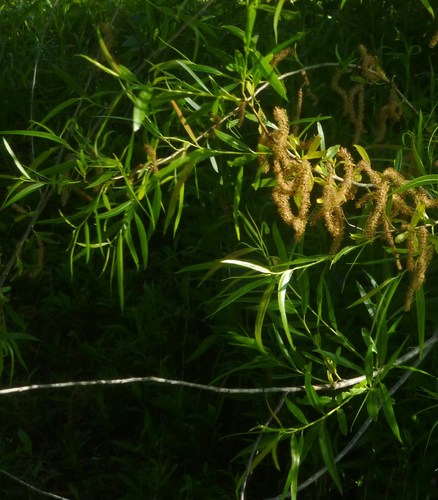
black willow
Salix nigra
The black willow is the largest of North America's native willows, a graceful giant often found leaning over riverbanks and wetlands. With its dark, craggy bark and shimmering canopy, it serves as a bustling hub for countless birds, mammals, and pollinators.
Quick Identification
Size
10-30 meters (30-100 feet) tall; trunk diameter 30-80 cm (12-32 inches)
Colors
Dark brown to near-black furrowed bark; bright green leaves with paler, silvery undersides; yellowish-green spring catkins
Key Features
- Deeply furrowed, dark brown to black bark on mature trees
- Long, narrow lance-shaped leaves with finely serrated edges
- Commonly grows with multiple trunks or a leaning habit
- Small, leaf-like stipules often found at the base of leaf stalks
When You’ll See Them
Geographic range
Where Does the black willow Live?
Native to the vast landscapes of North America, the black willow spans from the humid edges of New Brunswick and southern Ontario across the heart of the United States to the arid riparian corridors of Arizona and California. It is most densely concentrated throughout the Mississippi River Valley and the eastern seaboard, stretching south into the lush wetlands of northern Florida and the Gulf Coast of Texas. This hardy tree acts as a sentinel of the water's edge, thriving wherever there is consistent moisture and abundant sunlight.
Basemap © OpenStreetMap contributors
Behavior
The black willow is a fast-growing, pioneer species that plays a critical role in stabilizing riverbanks and preventing soil erosion. Unlike many other trees, it thrives with 'wet feet,' often growing directly in mud or shallow water. It is a resilient survivor, capable of regrowing from broken branches that wash downstream and lodge in moist soil, a process known as vegetative propagation.
Ecologically, the black willow acts as a massive 'wildlife hotel.' In the spring, its catkins provide one of the earliest sources of nectar for honeybees and native pollinators. Throughout the year, its dense canopy provides nesting sites for riparian birds, while its extensive, water-reaching root systems create underwater shelters for fish and amphibians. For humans, it is a hallmark of healthy wetland ecosystems and a natural filter for groundwater.
EverydayEarth exclusive
Camera Tips
Because the black willow thrives in riparian zones, it is the ultimate natural platform for capturing semi-aquatic wildlife. Position your camera on the lower trunk of a willow leaning over a riverbank or pond. Aim the lens toward the water's edge to capture beavers, river otters, and raccoons that use the tree's massive root systems as hiding spots or transit pathways. Use a wide-angle lens if possible, as these animals often move very close to the base of the tree searching for food.
The black willow’s rough, deeply furrowed bark provides excellent natural texture that helps camouflage trail cameras. For bird enthusiasts, mounting a camera on a sturdy branch looking toward the outer canopy can yield amazing shots of warblers, vireos, and woodpeckers. During the spring bloom (typically March to May), the tree's catkins attract swarms of insects, which in turn bring in flycatchers and other insectivores; set your camera to a high-speed trigger or video mode to capture these fast-moving hunters.
In the winter months, the black willow’s distinctive leaning silhouette provides a dramatic, structural background for your shots. If you are targeting larger mammals like white-tailed deer or bobcats, place the camera 10-15 feet back from the tree, facing a clear game trail that leads toward the water. The willow often serves as a landmark for these animals, and they frequently pause at its base to drink or scent-mark, providing the perfect 'still' moment for a high-quality photograph.
Similar Species
Species that look similar or are commonly confused with black willow.
Frequently Asked Questions
Record black willow at your habitat
Connect a camera to start building your own species record — AI identifies every visitor automatically.