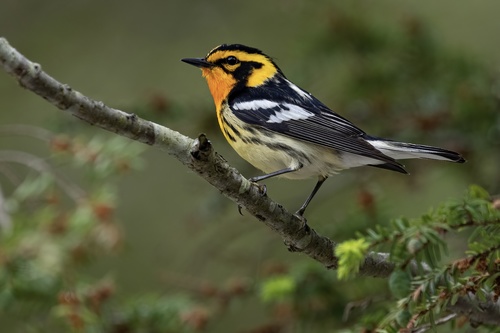
Blackburnian Warbler
Setophaga fusca
Known as the 'fire-throat' of the forest, the Blackburnian Warbler is a stunning gem of the high canopy. With its flaming orange plumage and high-pitched song, it is one of the most sought-after sightings for backyard birders during migration.
Quick Identification
Size
Length: 4.3–5.1 in (11–13 cm); Wingspan: 7.9–8.7 in (20–22 cm); Weight: 0.3–0.5 oz (8–13 g)
Colors
Adult males possess a brilliant fire-orange throat and face framed in black. Females and immatures show similar but muted patterns in pale yellow and olive-gray.
Key Features
- Brilliant flaming orange throat and breast on males
- Triangular black or gray cheek patch
- Large white wing bars on dark wings
- White belly with black streaks along the flanks
When You’ll See Them
Geographic range
Where Does the Blackburnian Warbler Live?
Native to the Americas, the Blackburnian Warbler is a long-distance traveler with a range that spans from the boreal forests of Canada down to the Andes Mountains. In the summer, they occupy a core breeding range stretching from the southern Canadian Prairies through the Great Lakes and New England, extending south along the Appalachian Mountains to North Carolina. As autumn approaches, they undertake an incredible journey across the Gulf of Mexico to their wintering grounds in southern Central America and northern South America, primarily in Colombia, Ecuador, and Peru. While they are occasional visitors to the western United States during migration, they are almost never found outside of the Western Hemisphere.
Basemap © OpenStreetMap contributors
Behavior
The Blackburnian Warbler is a high-canopy specialist, often spending its days foraging in the uppermost tips of coniferous trees. They are restless and energetic, moving with quick, jerky hops along branches as they glean insects from the undersides of needles. Because they prefer the highest reaches of the forest, they are often difficult to spot from the ground, frequently referred to by birders as 'neck-breakers' due to the angle required to see them.
During the breeding season, males are highly territorial and use their thin, high-pitched songs to defend their space in the hemlocks and spruces. Despite their solitary nature during nesting, they become quite social during migration, often joining mixed-species flocks with other warblers, kinglets, and chickadees as they journey between continents.
EverydayEarth exclusive
Camera Tips
Capturing a Blackburnian Warbler on a backyard camera is a rewarding challenge because they typically stay in the treetops. To bring them down to camera level, a moving water feature is your best tool. An elevated birdbath with a dripper or a small solar-powered fountain will attract them during their migration stopovers, as the sound of splashing water is irresistible to tired warblers looking to bathe and drink.
Place your camera approximately 3 to 5 feet away from the water source at a slight downward angle. Since these birds are incredibly fast, use a camera with a high trigger speed (0.2 seconds or less) and set it to 'Burst Mode' or 'Photo + Video' to ensure you catch the action. If your camera allows for shutter speed adjustment, aim for 1/1000th of a second or faster to freeze their rapid movements.
Position the setup in a spot that receives dappled sunlight rather than harsh, direct midday sun. This prevents the brilliant orange of the male's throat from 'blowing out' or overexposing in the image. In the spring (May) and late summer (August/September), focus your efforts on areas near mature trees, especially if you have evergreens like hemlock or pine nearby, as these act as natural magnets for the species.
Similar Species
Species that look similar or are commonly confused with Blackburnian Warbler.
Yellow-throated Warbler
Lacks the orange tones of the Blackburnian, featuring a bright yellow throat and a clean white eyebrow line.
American Redstart
While also orange and black, the Redstart has orange patches on its wings and tail rather than a solid orange throat.
Bay-breasted Warbler
Has a dark chestnut (not orange) throat and crown, and lacks the bright facial markings of the Blackburnian.
Frequently Asked Questions
Record Blackburnian Warbler at your habitat
Connect a camera to start building your own species record — AI identifies every visitor automatically.