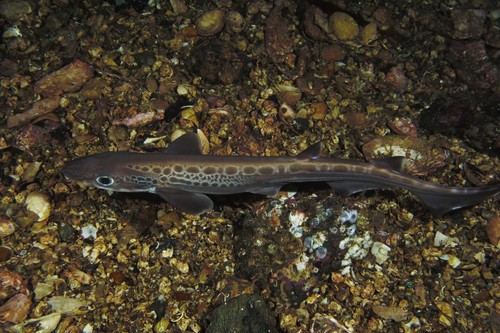
Blackmouth Catshark
Galeus melastomus
A master of the deep Atlantic slopes, the Blackmouth Catshark is named for its hidden, midnight-black maw and striking marbled skin. This elegant scavenger thrives in the darkness of the continental shelf, patrolling the muddy depths with cat-like eyes.
Quick Identification
Size
Total length typically ranges from 50–79 cm (20–31 in), with Atlantic specimens reaching up to 90 cm (35 in) and weighing around 1.4 kg (3 lbs).
Colors
Brownish-grey upper body with distinctive dark brown marbled saddles or blotches edged in white; the interior of the mouth is strikingly jet black.
Key Features
- Distinctive jet-black interior of the mouth
- Prominent saw-toothed crest of enlarged scales on the upper tail edge
- Series of dark, pale-edged marbled saddles along the back
- Slender, elongated body with large, almond-shaped eyes
When You’ll See Them
Geographic range
Where Does the Blackmouth Catshark Live?
Native to the Northeastern Atlantic Ocean and the Mediterranean Sea, the Blackmouth Catshark occupies a vast underwater territory. Its range extends from the cold waters of Iceland and the Norwegian Sea southward along the European coast to Senegal in West Africa. It is particularly common throughout the Mediterranean, where it is found across both the northern and southern basins, though it is notably absent from the Black Sea.
Basemap © OpenStreetMap contributors
Behavior
The Blackmouth Catshark is a resilient and adaptable deep-sea predator that spends much of its time near the muddy or sandy substrates of the continental slope. Unlike many open-ocean sharks, this species is not a high-speed cruiser; it is a bottom-oriented hunter that uses its keen sense of smell and electroreception to locate prey hidden in the dark. It is often found in relatively high densities, suggesting that while they are not strictly social, they congregate where food sources are abundant.
These sharks exhibit a slow-paced lifestyle suited to the low-energy environment of the deep sea. They are known to be relatively sedentary during certain periods, resting on the seabed. For humans, they pose no threat and are primarily encountered by deep-sea researchers or as bycatch in commercial fisheries. Interestingly, they have a thick layer of mucus on their skin which may serve as protection against parasites or skin abrasions from the rough seafloor.
EverydayEarth exclusive
Camera Tips
Capturing the Blackmouth Catshark requires specialized marine equipment, specifically a Baited Remote Underwater Video (BRUV) system or a deep-rated drop camera. Because these sharks live at depths starting around 150 meters, standard consumer waterproof housings will fail; you must use a pressure-rated enclosure (aluminum or thick acrylic) capable of withstanding at least 20 atmospheres. Since natural light doesn't penetrate these depths, high-lumen underwater LEDs are essential. To avoid scaring the sharks, consider using red-spectrum filters, as many deep-sea species are less sensitive to red light.
Placement is critical: target the 'shoulder' of the continental slope where the seafloor begins to drop off sharply, looking for muddy or silty bottoms. A heavy anchor system is necessary to keep your camera stable against deep-water currents. For bait, use highly oily fish such as mackerel, sardines, or chopped squid secured in a mesh bag or 'bait arm' positioned about 1 meter in front of the lens. This creates a scent trail (plume) that the catshark's sensitive nose will follow directly to your camera's field of view.
Set your camera to record in high frame rates (60fps) if possible, as their movements can be jerky when competing for bait. Because battery life is limited in cold, deep water, use a motion-activated trigger if your hardware supports it, or set a timer to record for 5-minute intervals every hour. If you are using an AI-powered system like EverydayEarth's marine modules, train the detection model to look for the distinctive marbled saddles, which provide high contrast against the dull grey-brown of the seafloor.
Similar Species
Species that look similar or are commonly confused with Blackmouth Catshark.
Frequently Asked Questions
Record Blackmouth Catshark at your habitat
Connect a camera to start building your own species record — AI identifies every visitor automatically.