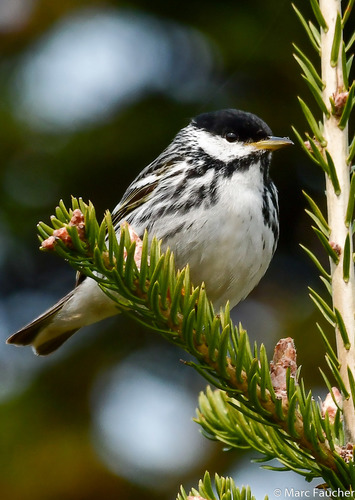
Blackpoll Warbler
Setophaga striata
Meet the marathon runner of the bird world. The Blackpoll Warbler performs an incredible non-stop flight across the Atlantic, stopping briefly in backyards to refuel its tiny, energetic body.
Quick Identification
Size
Length 12–15 cm (4.7–5.9 in), Wingspan 20–25 cm (7.9–9.8 in), Weight 11–20 g (0.4–0.7 oz)
Colors
Breeding males have a striking black cap and white cheeks. Both sexes feature two white wing bars and distinct orange-yellow legs. Fall adults are greenish-yellow with faint streaks.
Key Features
- Solid black cap and white cheeks on breeding males
- Bright orange-yellow legs and feet in all plumages
- Two prominent white wing bars
- High-pitched, accelerating 'seet-seet-seet' song
When You’ll See Them
Geographic range
Where Does the Blackpoll Warbler Live?
Native to North America, the Blackpoll Warbler boasts one of the most extensive breeding ranges of any New World warbler, stretching from the forests of Alaska across the vast Canadian wilderness to the mountains of New England. As a migratory marvel, they travel south through the United States and the Caribbean to reach their wintering grounds in northern South America, primarily in the Amazon basin and the foothills of the Andes. They are most commonly spotted by backyard enthusiasts in the Eastern United States during their brief stopovers in the spring and autumn.
Basemap © OpenStreetMap contributors
Behavior
The Blackpoll Warbler is a master of endurance, famous for its non-stop overwater migration from the Northeastern United States to South America. During the breeding season, they are somewhat reclusive, nesting in the dense conifers of the boreal forest. They move with a deliberate, almost sluggish pace compared to other frantic warblers, carefully gleaning insects from the undersides of leaves in the upper canopy.
During migration, they become more visible in suburban gardens and parks, often joining mixed-species flocks. While they aren't social with humans, they are often indifferent to birdwatchers, allowing for relatively close observation if you can spot them through the foliage. Their presence in your backyard is a fleeting but spectacular sign of the changing seasons as they refuel for their record-breaking journey.
EverydayEarth exclusive
Camera Tips
Capturing a Blackpoll Warbler on camera requires precision, as these birds typically prefer the high canopy. To bring them within range of a backyard AI camera, focus on water features. A birdbath with a solar-powered dripper or a small fountain is your best bet; the sound of moving water is an irresistible lure for migrating warblers looking to hydrate and bathe. Position your camera about 2 to 3 feet from the water source, angled slightly downward to capture the bird's orange-yellow legs, which are a definitive ID trait.
Since they are most active during the early morning hours of peak migration (May and September), ensure your camera is set to its highest trigger sensitivity and rapid-fire burst mode. These birds move slowly for warblers, but they are still small and can be obscured by splashing water. Using a camera with a macro lens or a narrow field of view will help highlight the fine details of their streaked plumage and 'tuxedo' cap.
Avoid placing the camera in direct sunlight, which can blow out the white patches on the male's cheeks and belly. Instead, seek dappled shade or use a lens hood. If you have berry-producing shrubs like elderberry or dogwood, consider placing a secondary camera nearby, as these provide the high-energy fuel Blackpolls crave before their long-distance flight over the Atlantic.
Similar Species
Species that look similar or are commonly confused with Blackpoll Warbler.
Frequently Asked Questions
Record Blackpoll Warbler at your habitat
Connect a camera to start building your own species record — AI identifies every visitor automatically.