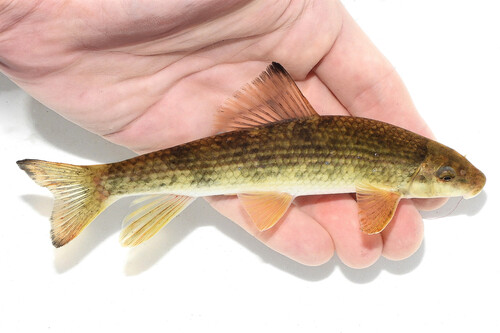
Blacktip Jumprock
Moxostoma cervinum
A master of the mountain stream, the Blacktip Jumprock is a specialized sucker fish known for its striking fin markings and energetic 'jumping' behavior along rocky riverbeds.
Quick Identification
Size
Small and slender, typically ranging from 15 to 19 cm (6 to 7.5 inches) in length and weighing less than 0.2 kg (0.5 lbs).
Colors
Olive-bronze to brownish back with a pale yellowish-white belly; most notably features distinct jet-black tips on the dorsal and caudal (tail) fins.
Key Features
- Prominent black tipping on the dorsal and tail fins
- Inferior, sucking mouth with specialized plicate lips
- Slender, cylindrical body shape for navigating fast currents
- Dark edges on scales creating a faint diamond or crisscross pattern
When You’ll See Them
Geographic range
Where Does the Blacktip Jumprock Live?
Native to the North American continent, the Blacktip Jumprock is a regional specialist of the Southeastern United States. Its core range is concentrated within the Atlantic slope drainages, spanning from the Roanoke River basin in Virginia down through the Chowan, Tar, Neuse, Cape Fear, and Yadkin-Pee Dee River systems in North and South Carolina. It is most commonly found in the Piedmont region where the transition from mountains to coastal plains creates the perfect rocky stream conditions.
Basemap © OpenStreetMap contributors
Behavior
The Blacktip Jumprock is a highly specialized bottom-dweller that spends its life navigating the rocky substrates of river beds. Unlike many fish that cruise the mid-water column, jumprocks stay close to the stones, using their specialized mouths to 'scrape' and suction food from the surface of rocks. They are named for their unique movement style; they appear to 'jump' or hop from one rock to another in sudden, jerky bursts rather than swimming in a continuous, fluid motion.
These fish are generally solitary or found in small, loose groups. They are very sensitive to their environment, particularly water clarity and the presence of silt. Because they rely on visual foraging and clean rocky surfaces to find food, they are often used by biologists as biological indicators of high water quality. While they are wary of large disturbances, they can be observed by patient snorkelers or via underwater camera setups as they go about their industrious foraging.
EverydayEarth exclusive
Camera Tips
Capturing high-quality footage of a Blacktip Jumprock requires an underwater approach. Use a waterproof action camera or a specialized aquatic trail camera secured to a weighted base or a heavy stone. The best placement is in shallow 'riffles'—those areas where the water ripples over submerged rocks. Position the camera lens about 2 to 4 inches above the riverbed, angled slightly downward to capture the fish as they graze across the stones.
Lighting is the most significant challenge in underwater river photography. Choose a spot where the sun penetrates the forest canopy during midday (10 AM to 2 PM). Clear water is essential; if there has been a recent heavy rain, wait 48 to 72 hours for the sediment to settle and the water to clear up, otherwise, your camera will struggle to focus on the fish and the black-tipped fins won't be visible.
Since Blacktip Jumprocks are fast and their movements are jerky, set your camera to a high frame rate, such as 60fps or 120fps. This allows you to review the footage in slow motion to see the 'jumping' behavior and the way they use their fins to anchor themselves against the current. While you don't need traditional bait, you can gently turn over a few rocks just upstream of your camera to release aquatic larvae into the current, which may draw jumprocks into your frame to investigate the sudden food source.
Similar Species
Species that look similar or are commonly confused with Blacktip Jumprock.
Frequently Asked Questions
Record Blacktip Jumprock at your habitat
Connect a camera to start building your own species record — AI identifies every visitor automatically.