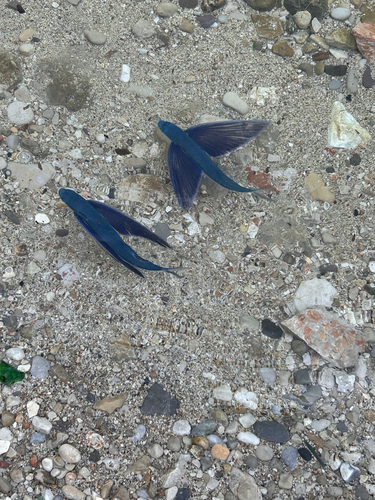
Blackwing Flyingfish
Hirundichthys rondeletii
The Blackwing Flyingfish is a spectacular 'bird of the sea' that uses wing-like fins to glide over the waves. Witness one of nature's most incredible escape acts as they soar across the ocean surface to outrun predators.
Quick Identification
Size
25-30 cm (10-12 inches) in length; typically weighs 0.2-0.5 kg (0.5-1.1 lbs)
Colors
Iridescent dark blue to black on the dorsal side with a brilliant silvery-white belly; pectoral fins are dark/smoky with a narrow transparent margin
Key Features
- Extraordinarily long, wing-like pectoral fins
- Deeply forked tail with a significantly longer lower lobe
- Sleek, torpedo-shaped body for high-speed swimming
- Dark, ink-colored 'wings' that lack the spots found in similar species
When You’ll See Them
Geographic range
Where Does the Blackwing Flyingfish Live?
The Blackwing Flyingfish is a cosmopolitan traveler found across the globe in the warm subtropical and tropical waters of the Atlantic, Pacific, and Indian Oceans. It is a common sight in the Mediterranean Sea and along the Gulf Stream, often ranging as far north as the British Isles and Massachusetts during the peak of summer. In the southern hemisphere, its range extends to the waters surrounding Australia, South Africa, and Brazil, following the shifting 20°C isotherms.
Basemap © OpenStreetMap contributors
Behavior
The Blackwing Flyingfish is a marvel of evolutionary engineering, famous for its ability to escape underwater predators by launching itself into the air. By vibrating its specialized tail up to 50 times per second while still submerged, it generates enough thrust to break the surface at speeds exceeding 35 miles per hour. Once airborne, it spreads its large pectoral fins to glide for distances of 150 feet or more, occasionally touching the water with its tail to 'taxi' and extend its flight.
In the water, these fish are generally social and can be found in loose schools, particularly in areas where ocean currents concentrate plankton. They are primarily nocturnal feeders, rising to the surface under the cover of darkness to avoid the sharp eyes of birds, though they must then contend with predatory fish like tuna and billfish. Humans often encounter them near boats, as they are frequently startled into flight by passing hulls or attracted to deck lights at night.
EverydayEarth exclusive
Camera Tips
Capturing the Blackwing Flyingfish requires a unique camera setup, ideally positioned on a dock, pier, or the transom of a boat. Because these fish are most famous for their aerial glides, your camera should be mounted roughly 1 to 2 feet above the water level, angled horizontally across the surface rather than looking straight down. This side-on profile is essential for capturing the 'wings' in full extension and the dramatic splash of the tail during takeoff.
To get the best results, take advantage of their natural phototaxis—their attraction to light. Mounting a high-intensity LED light near your camera lens at night will draw them toward the sensor. Use a fast shutter speed (at least 1/1000s) or a high-frame-rate video setting, as their glides are incredibly fast. Standard trail camera triggers may be too slow for the initial breach, so a 'pre-roll' or continuous loop recording feature is highly recommended to catch the split-second action.
If you are setting up a camera in a coastal 'backyard,' focus on areas with high current or near underwater lights that already attract baitfish. Use a polarizing filter during daylight hours to eliminate surface glare, which helps the AI detection system distinguish the dark silhouette of the fish from the reflective ocean surface. Ensure your equipment is rated for marine environments (IP68 or higher), as salt spray is highly corrosive to standard electronics.
Frequently Asked Questions
Record Blackwing Flyingfish at your habitat
Connect a camera to start building your own species record — AI identifies every visitor automatically.