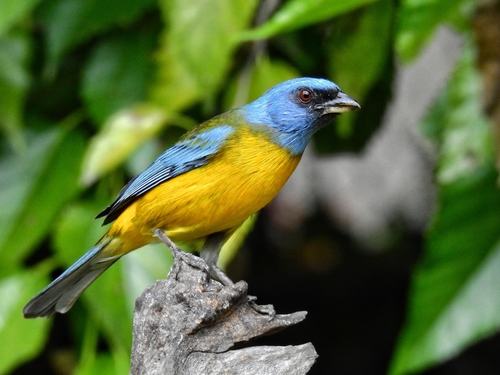
Blue-and-yellow Tanager
Rauenia bonariensis
A vibrant splash of sapphire and gold, the Blue-and-yellow Tanager is a frequent and welcome visitor to gardens across South America. This hardy and adaptable bird brings a tropical flair to backyard feeders with its striking plumage and energetic personality.
Quick Identification
Size
Length: 16–18 cm (6.3–7.1 in); Weight: 30–45 g (1.1–1.6 oz)
Colors
Males have a brilliant cobalt-blue head and wings, a black back, and bright yellow to orange underparts. Females are duller, with olive-brown bodies and a subtle blue-grey wash on the crown.
Key Features
- Vibrant blue hood and wing coverts (males)
- Bright yellow or orange-yellow breast and belly
- Deep black mantle and back
- Stubby, dark bill and dark eyes
When You’ll See Them
Geographic range
Where Does the Blue-and-yellow Tanager Live?
The Blue-and-yellow Tanager is native to South America, where it enjoys a massive and diverse range across the southern and central parts of the continent. It is most commonly found throughout the Pampas of Argentina, Uruguay, and Southern Brazil, but its reach extends westward into the Andean valleys of Bolivia, Chile, Peru, and Ecuador. Because it thrives in semi-open landscapes, it has successfully expanded into many urbanized areas across these nations, making it one of the most widely recognized tanagers in the region.
Basemap © OpenStreetMap contributors
Behavior
The Blue-and-yellow Tanager is a socially active and conspicuous bird, often seen moving through the canopy in pairs or small family groups. Unlike some more reclusive forest species, they are quite bold and have adapted exceptionally well to human presence, frequently visiting backyard gardens and city parks. They are highly energetic, constantly flitting between branches in search of food, and are known for their short, twittering songs that are most frequent during the early morning hours.
These birds are primarily arboreal, rarely descending to the ground except to visit low-lying fruit bushes or bird baths. During the breeding season, they become more territorial, though they may still join mixed-species foraging flocks outside of the nesting period. Their interaction with humans is generally positive, as they are easily attracted to feeders and provide natural pest control by gleaning insects from garden foliage.
EverydayEarth exclusive
Camera Tips
To capture the stunning colors of the Blue-and-yellow Tanager, position your camera near a reliable food source. These birds are highly attracted to 'fruit platforms'—flat feeders where you can place halved bananas, overripe papayas, or oranges. Mount the camera approximately 4 to 6 feet high, level with the feeder or a nearby 'staging branch' where the birds typically land to survey the area before eating.
Lighting is critical for this species; their blue plumage is structural and looks best in bright, indirect morning light. Avoid placing the camera where it will face the direct midday sun, which can wash out the deep yellow of their breast. A fast shutter speed or a high-frame-rate video setting is recommended, as these tanagers are quick, nervous feeders that rarely stay still for long.
Water is another excellent draw. A solar-powered bird fountain or a shallow stone bath can attract them for spectacular bathing shots. Because they are resident birds, you can keep your camera active year-round. In the winter months, when natural fruit is scarce, they will visit feeders more frequently, providing some of your best opportunities for close-up portraits.
Similar Species
Species that look similar or are commonly confused with Blue-and-yellow Tanager.
Frequently Asked Questions
Record Blue-and-yellow Tanager at your habitat
Connect a camera to start building your own species record — AI identifies every visitor automatically.