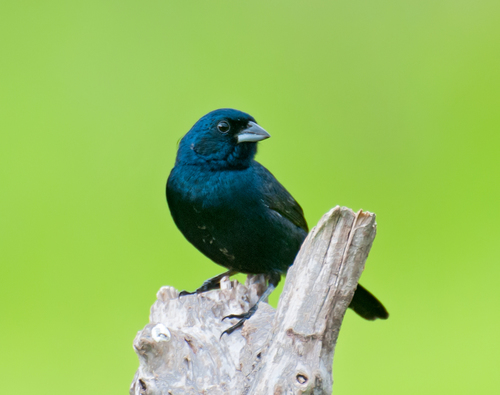
Blue-black Grassquit
Volatinia jacarina
Meet the 'Johnny Jump-up,' a tiny, iridescent bird known for its acrobatic vertical displays and charming buzzy song. A common resident of tropical gardens, this energetic tanager is a delight for backyard observers.
Quick Identification
Size
Length: 10–10.5 cm (3.9–4.1 in); Weight: 7–12 g (0.25–0.42 oz)
Colors
Males are a glossy, iridescent blue-black with white patches under the wings. Females and juveniles are olive-brown above and buffy-white below with dark streaking on the breast.
Key Features
- Glossy blue-black plumage in breeding males
- Unique 'jump-up' vertical display
- Small, conical seed-eating bill
- White wing linings visible during flight
When You’ll See Them
Geographic range
Where Does the Blue-black Grassquit Live?
Native to the Neotropical realm, the Blue-black Grassquit is a widespread species found throughout Central and South America. Its core range extends from southern Mexico through the Central American isthmus into South America, reaching as far south as northern Argentina, Chile, and Paraguay. It is also a permanent resident of Caribbean islands like Trinidad and Tobago, and while it is primarily a tropical bird, occasional vagrants are spotted as far north as the southern border of the United States.
Basemap © OpenStreetMap contributors
Behavior
The Blue-black Grassquit is most famous for its extraordinary aerial display, which has earned it the nickname 'Johnny Jump-up.' During the breeding season, males find a prominent perch—often a fence wire or a sturdy grass stalk—and perform a series of rapid vertical leaps. They spring several inches into the air, momentarily flashing their white underwing patches, and emit a buzzy, mechanical-sounding call before landing back on the exact same spot. This display is performed repeatedly throughout the day to mark territory and attract females.
Outside of the breeding season, these birds are highly social and are frequently seen in small, busy flocks alongside other seedeaters and grassquits. They are active foragers, spending much of their time on the ground or clinging to the seed heads of tall grasses. While they are generally shy of humans in the deep wild, they have adapted remarkably well to human-modified landscapes and are common sights in rural gardens and city parks across the tropics.
EverydayEarth exclusive
Camera Tips
To capture the Blue-black Grassquit's signature move, camera placement is everything. Set your camera at a low angle, roughly 1 to 2 feet off the ground, targeting a fence line, a low branch, or a patch of tall, seeding grass. Because the 'jump-up' display is lightning-fast, you should use a camera with a high trigger speed and a short recovery time. If your device supports video, recording at a high frame rate (60fps or higher) will allow you to see the beautiful white wing patches that are otherwise a blur to the human eye.
Attracting these birds to your camera’s field of view is best achieved by providing their natural food source. If you have a backyard, leave a patch of native grass to grow tall and produce seeds; Blue-black Grassquits are particularly fond of Guinea grass. A shallow, ground-level bird bath or a slow-dripping water feature is also a magnetic draw for them, as they prefer to drink and bathe in safe, low-to-the-ground spots.
Lighting is crucial for getting the best image of a male grassquit. In flat light, they often appear as simple black birds. Try to position your camera so the morning sun hits the bird’s perch directly. This will illuminate the structural blue iridescence of their feathers, making them pop against the green or brown background. Use 'burst mode' if available, as a single shot often misses the peak of the leap or the moment the wings are fully extended.
Similar Species
Species that look similar or are commonly confused with Blue-black Grassquit.
Yellow-bellied Seedeater
The male has a bright yellow belly and a black hood, unlike the solid dark Blue-black Grassquit.
Variable Seedeater
Males usually have white patches on the wing and a white belly or collar, and lack the iridescent blue sheen.
Slate-colored Seedeater
Features a massive yellow bill and slate-gray plumage rather than iridescent blue-black.
Frequently Asked Questions
Record Blue-black Grassquit at your habitat
Connect a camera to start building your own species record — AI identifies every visitor automatically.