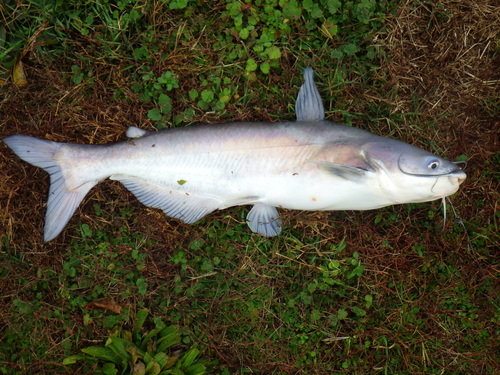
Blue Catfish
Ictalurus furcatus
The Blue Catfish is North America's undisputed heavyweight of the river, a slate-blue giant that rules the deep channels of the Mississippi and beyond.
Quick Identification
Size
Typically 25–46 in (64–117 cm) and 30–70 lb (14–32 kg); can reach up to 65 in (165 cm) and 143 lb (65 kg)
Colors
Slate blue to silvery-gray on the back and sides, fading to a white belly; skin is smooth and lacks the dark spots seen on younger Channel Catfish
Key Features
- Deeply forked tail fin
- Straight-edged anal fin with 30-35 rays
- Slate-blue coloration without spots
- Broad, flat head with four pairs of dark barbels (whiskers)
When You’ll See Them
Geographic range
Where Does the Blue Catfish Live?
Native to North America, the Blue Catfish is primarily found within the massive Mississippi River drainage, extending through the Missouri, Ohio, and Rio Grande basins. Its range reaches as far south as the Gulf Coast of Mexico and into parts of Belize and Guatemala. In recent decades, it has been widely introduced to Atlantic slope drainages, most notably in the Chesapeake Bay and various reservoirs across the southeastern United States, where it has established booming populations.
Basemap © OpenStreetMap contributors
Behavior
Blue Catfish are the powerful apex predators of North American river systems. Unlike many other catfish species that prefer sluggish backwaters, the Blue Catfish thrives in the swifter currents of main river channels and deep pools. They are highly active swimmers and often roam long distances to follow schools of baitfish or to find optimal water temperatures during seasonal changes.
While they are capable of being social, especially when congregating in deep wintering holes, they are generally solitary hunters. They are well-known for their longevity, often living over 20 years. In areas where they have been introduced, such as the Chesapeake Bay, they have shown remarkable adaptability to brackish water, proving themselves to be resilient and dominant competitors in diverse aquatic environments.
EverydayEarth exclusive
Camera Tips
Capturing a Blue Catfish on camera requires specialized underwater equipment, as these giants spend most of their time patrolling the riverbed. Use a submersible action camera or a dedicated underwater trail camera. For the best results, mount the camera on a weighted base or a pier piling, positioning it 1 to 2 feet above the bottom. Angle the lens slightly downward to catch the fish as they cruise along the substrate searching for food.
Because water clarity is often low in their preferred habitats, scent is your best friend for a successful photo or video. Use a mesh bait bag filled with cut shad, skipjack herring, or commercial stink baits. Secure the bag just within the camera's periphery; the scent trail will draw the catfish directly in front of the lens. This is particularly effective at night, when the catfish's sensitive barbels lead them straight to the source of the smell.
Visibility is the biggest challenge when filming underwater. Try to place your camera in areas with rocky or gravel bottoms rather than mud to minimize silt clouds. If your camera has infrared (IR) capabilities, it will help illuminate the fish in dark or murky water without scaring them off. During the late spring spawning season, look for cameras placements near underwater structures like large logs or rock crevices where they may be more stationary.
If you live in a coastal area, pay attention to the tides. Blue Catfish in tidal rivers are most active during a moving tide—either incoming or outgoing. Setting your camera to record during these windows will significantly increase your chances of seeing a trophy-sized specimen as it moves into shallower areas to feed.
Similar Species
Species that look similar or are commonly confused with Blue Catfish.
Frequently Asked Questions
Record Blue Catfish at your habitat
Connect a camera to start building your own species record — AI identifies every visitor automatically.