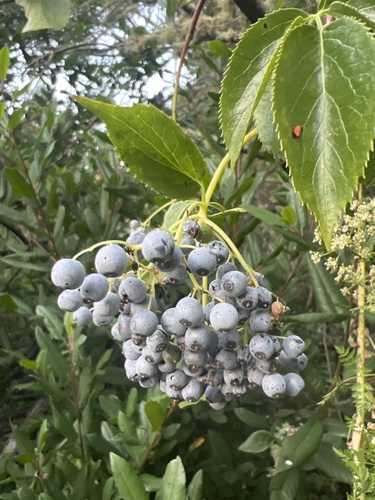
Blue Elderberry
Sambucus mexicana
A powerhouse of the western landscape, the Blue Elderberry is nature's grocery store, offering a year-round spectacle of creamy blooms and frosted blue berries that attract everything from hummingbirds to foxes.
Quick Identification
Size
A large deciduous shrub or small tree reaching 2-9 meters (6-30 feet) in height and 3-6 meters (10-20 feet) in width.
Colors
Creamy white to pale yellow flowers; bright green foliage; dark blue to nearly black berries covered in a distinctive powdery, waxy blue coating (bloom).
Key Features
- Large, flat-topped clusters of tiny cream-colored flowers
- Dark blue berries with a waxy, pale blue 'bloom' that makes them appear light blue
- Opposite, pinnately compound leaves with 5-9 serrated leaflets
- Light gray or brown bark that becomes deeply furrowed and corky with age
When You’ll See Them
Geographic range
Where Does the Blue Elderberry Live?
Native to the western half of North America, the Blue Elderberry has a wide geographic footprint that stretches from southern British Columbia and Alberta down through the Pacific Coast states of Washington, Oregon, and California. Its core range extends eastward into the Rocky Mountain states, reaching as far as West Texas and deep into the mountain ranges of northern and central Mexico. This hardy species is a hallmark of Mediterranean climates and temperate woodland transition zones across the West.
Basemap © OpenStreetMap contributors
Behavior
The Blue Elderberry is a fast-growing, opportunistic woody plant that serves as a vital 'service station' for local wildlife. Unlike many plants that have a narrow window of interest, this species provides resources across multiple seasons. In the spring and early summer, its massive floral displays act as a magnet for a diverse array of pollinators, including butterflies, hoverflies, and native bees. Because it produces nectar and pollen in such high volumes, it often becomes the center of insect activity in a backyard setting.
As the seasons shift to late summer and autumn, the plant undergoes a transformation, drooping under the weight of heavy berry clusters. This is when the social dynamics of the backyard change; the shrub becomes a bustling hub for frugivorous birds and opportunistic mammals. While the plant itself is stationary, its 'behavior' is defined by its resilience; it can die back during extreme droughts only to sprout vigorously from the root crown when water returns, making it a permanent fixture of the landscape once established.
EverydayEarth exclusive
Camera Tips
To capture the incredible biodiversity that Blue Elderberry attracts, place your camera approximately 3 to 5 feet off the ground, angled slightly downward toward a large cluster of ripening berries. Because these shrubs can grow quite dense, look for 'flight paths' or clearings in the foliage where birds like Western Bluebirds, Cedar Waxwings, and Scrub Jays are likely to perch before diving into the fruit. Using a 'Macro' or 'Close-Focus' setting on your camera—if available—is ideal for capturing the intricate details of the berries and the small birds that feed on them.
During the late summer berry peak, set your camera to 'Burst Mode' or high-frame-rate video. Birds often move rapidly through the branches, and a single photo may miss the action. If you are targeting mammalian visitors like Gray Foxes, Raccoons, or Striped Skunks who come to scavenge fallen fruit, place a second camera at ground level (6-12 inches high) near the base of the trunk. These animals are most active at night, so ensure your camera has a high-quality infrared flash that won't overexpose the pale, waxy berries, which can be highly reflective.
Don't ignore the flowering phase in late spring. While most people use trail cams for larger animals, a camera with a fast trigger speed can capture stunning footage of hummingbirds and large butterflies visiting the cream-colored blooms. For the best lighting, position your camera facing North or South to avoid the harsh glare of the rising or setting sun through the leaves, which can cause false triggers or 'white-out' images.
Frequently Asked Questions
Record Blue Elderberry at your habitat
Connect a camera to start building your own species record — AI identifies every visitor automatically.