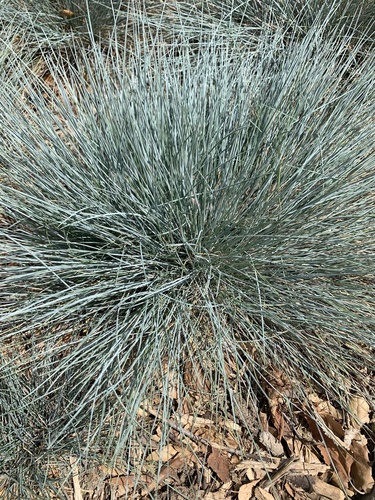
Blue Fescue
Festuca glauca
A striking, mounded ornamental grass known for its icy blue-gray foliage and tidy growth habit. Perfect for adding metallic texture and year-round interest to backyard rock gardens and borders.
Quick Identification
Size
15–30 cm (6–12 in) tall and wide
Colors
Powder-blue, silver-gray, and icy-blue foliage; light tan or buff flowers
Key Features
- Tight, mounded cushion-like shape
- Fine-textured needle-like blades
- Steel-blue or silvery evergreen foliage
- Wheat-colored flower spikes in summer
When You’ll See Them
Geographic range
Where Does the Blue Fescue Live?
Blue Fescue is originally native to the temperate regions of Europe, particularly across central and southern areas like France, Italy, and Switzerland, where it thrives in rocky, mountainous terrain. It has since been introduced globally as a popular ornamental plant and is now common in residential landscapes and public parks across North America, Australia, and New Zealand. Because it is highly adaptable to various soil types and drought-tolerant, it is frequently found in suburban garden borders throughout most temperate climate zones worldwide.
Basemap © OpenStreetMap contributors
Behavior
In the late spring and summer, the plant sends up tall, narrow flower stalks that start out a pale green and eventually transition to a golden-buff color. These seed heads provide subtle visual interest and are often visited by small songbirds for nesting material or seeds. While the plant is relatively short-lived compared to other perennials, typically lasting 3-5 years, it is easily rejuvenated by dividing the clumps in early spring.
EverydayEarth exclusive
Camera Tips
Capturing Blue Fescue on a backyard camera is less about tracking the plant itself and more about using its unique structure to spot the wildlife that visits it. Position your camera at a low angle, about 6 to 12 inches off the ground, to catch small mammals like voles, rabbits, or even ground-foraging birds that may use the dense clumps for cover. The silver-blue foliage provides excellent color contrast, making it significantly easier for AI recognition software to distinguish between the plant and a moving animal passing in front of it.
Because the fine blades of Blue Fescue are sensitive to wind, they can often trigger motion-based trail cameras unnecessarily. To avoid filling your SD card with 'ghost' triggers, try to place the camera so the grass is in the lower third of the frame rather than the center, or decrease the motion sensitivity settings during windy days. If your camera has a 'Time Lapse' mode, this is a fantastic species to observe over a season, showing the slow transition from tight blue mounds to the emergence of tall, golden flower spikes in mid-summer.
For the best visual quality, aim the camera so the sun is behind the grass during the 'golden hour' of early morning or late afternoon. This backlighting makes the blue-gray blades appear to glow and highlights the delicate texture of the flower heads. If you are hoping to capture insect visitors like native bees or butterflies, use a macro focus setting if available, as they are often attracted to the subtle blooms between June and July. During winter, these mounds often stand out against the snow, providing a perfect backdrop for tracking bird activity when other vegetation has died back.
Similar Species
Species that look similar or are commonly confused with Blue Fescue.
Frequently Asked Questions
Record Blue Fescue at your habitat
Connect a camera to start building your own species record — AI identifies every visitor automatically.