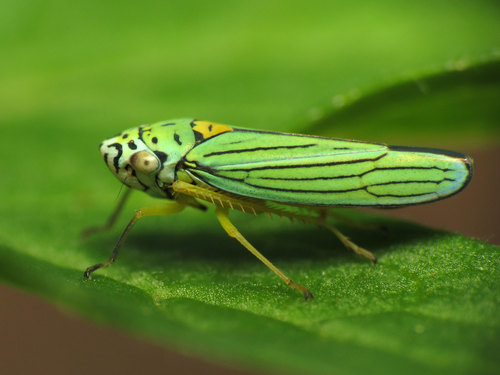
Blue-green Sharpshooter
Graphocephala atropunctata
A vibrant jewel of the garden, the blue-green sharpshooter is a master of camouflage and a powerful jumper. While famous for its role in California's wine country, this tiny insect is a fascinating example of high-speed sap processing and agile movement.
Quick Identification
Size
6–9 mm (0.24–0.35 inches) in length
Colors
Brilliant turquoise or blue-green on the head, thorax, and wings; bright yellow on the legs and underside; small black spots on the crown of the head.
Key Features
- Vibrant electric-blue or teal dorsal coloration
- Bright yellow legs and underbelly
- Distinctive black spots on the head and thorax
- Streamlined, wedge-shaped body typical of leafhoppers
When You’ll See Them
Geographic range
Where Does the Blue-green Sharpshooter Live?
Native to the North American continent, the blue-green sharpshooter is a signature resident of the American West. Its core range spans the Pacific Coast from California through Oregon and Washington, while also extending inland into the arid environments of Arizona and New Mexico. While it thrives in the Mediterranean climate of the California coast, it is frequently found in any well-irrigated suburban landscape within these states.
Basemap © OpenStreetMap contributors
Behavior
The blue-green sharpshooter is a remarkably active member of the leafhopper family. It is best known for its "sidling" behavior—when it senses a threat, it quickly scoots to the opposite side of a plant stem to remain hidden, much like a squirrel circling a tree trunk. Despite their small size, they are powerful jumpers, using their specialized hind legs to launch themselves into the air when disturbed.
The name "sharpshooter" refers to a unique physiological habit. Because these insects feed on xylem sap, which is mostly water and very low in nutrients, they must consume vast quantities of it to survive. They process this liquid rapidly and forcibly eject droplets of excess waste from their rear, sometimes at such a rate that it sounds like a light rain hitting the leaves below them.
EverydayEarth exclusive
Camera Tips
Capturing the blue-green sharpshooter on camera requires a lens capable of macro or extreme close-up detail. Because they are less than a centimeter long, standard trail cameras may struggle to trigger on their movement. Instead, use an AI-powered backyard camera with a dedicated macro focus range or a modified lens. Position the camera just 6 to 10 inches away from known host plants like California wild grape, blackberry canes, or English ivy.
Lighting is crucial for highlighting their iridescent blue-green sheen. Aim your camera at stems that receive direct morning sunlight; these insects often bask to regulate their temperature before they begin feeding in earnest. Since they are prone to hiding on the far side of stems, try setting up two cameras at different angles on a single branch to increase your chances of a clear profile shot.
To attract them to your camera's field of view, ensure your backyard has plenty of moisture. These bugs are attracted to succulent, water-rich growth. If you have a drip irrigation line or a small water feature, placing your camera near the lush vegetation in that immediate area will provide the highest encounter rate. They are most active during the warm months of spring and early summer, so this is the best time to monitor your station.
Similar Species
Species that look similar or are commonly confused with Blue-green Sharpshooter.
Frequently Asked Questions
Record Blue-green Sharpshooter at your habitat
Connect a camera to start building your own species record — AI identifies every visitor automatically.