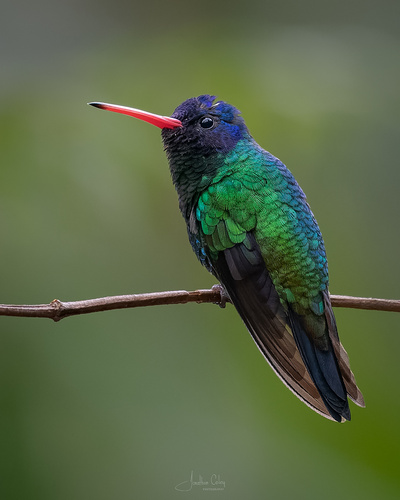
Blue-headed Sapphire
Chrysuronia grayi
A glittering jewel of the Pacific lowlands, the Blue-headed Sapphire dazzles with its brilliant violet-blue crown and energetic aerial displays. Common in the gardens of Colombia and Ecuador, this small but feisty hummingbird is a favorite for backyard birders.
Quick Identification
Size
8.5 to 9.5 cm (3.3 to 3.7 inches) in length; weight range of 4.5 to 5.5 grams (0.16 to 0.19 oz)
Colors
Males feature a brilliant violet-blue head and throat with metallic green upperparts and a blue-black tail. Females have green upperparts and white underparts speckled with green.
Key Features
- Vibrant iridescent blue head and throat (males)
- Medium-length, straight black bill
- Deep blue to blue-black slightly forked tail
- White underparts with green spotting (females)
When You’ll See Them
Geographic range
Where Does the Blue-headed Sapphire Live?
The Blue-headed Sapphire is native to the northern Andes region of South America. Its range is primarily concentrated along the Pacific slope, stretching from western Colombia through western Ecuador. This species is a regional specialist, thriving in the humid tropical zones where forest meets open clearings, and it does not have any known introduced populations outside of its native South American range.
Basemap © OpenStreetMap contributors
Behavior
The Blue-headed Sapphire is a high-energy, territorial hummingbird that is a delight to observe in its native tropical environment. Like many members of the emerald tribe, it is fiercely protective of its feeding grounds, often engaging in high-speed aerial dogfights to chase away rivals from prime nectar sources. Despite their small size, they are incredibly bold and will defend a single flowering tree or a backyard feeder against much larger bird species.
During the day, these hummingbirds follow a 'trap-lining' route or defend specific territories depending on the abundance of flowers. While they are solitary birds that do not form flocks, they are frequently seen in the same vicinity as other hummingbirds at forest edges. Their flight is characterized by rapid, darting movements, making them a challenge but a reward for any backyard observer or photographer.
EverydayEarth exclusive
Camera Tips
To capture the stunning iridescence of the Blue-headed Sapphire, camera placement is everything. These birds are most active in the early morning when nectar levels are highest, so set your camera to trigger during the first light of day. Because of their incredible speed, use a camera with a fast shutter speed (at least 1/1000s if possible) or high-frame-rate video settings. Position the camera 3 to 5 feet away from a nectar source, such as a hummingbird feeder or a cluster of red tubular flowers like Heliconias.
Lighting is the 'secret sauce' for this species. To ensure the blue head of the male doesn't just look black, place your camera with the sun at its back, shining directly onto the bird's favorite perching or feeding spot. This front-lighting will cause the microscopic structures in the feathers to refract light, revealing the brilliant sapphire and emerald tones. If your camera has a 'burst mode' or 'pre-roll' feature, enable it; these birds often hover for only a few seconds before darting away.
For backyard setups, use a feeder with a perch to encourage the bird to stay still for a few seconds. If you are using a trail camera, ensure it has a fast PIR (Passive Infrared) sensor trigger time, ideally under 0.2 seconds. Mounting the camera at a height of 4 to 6 feet—standard flower height—will give you the most natural perspective. Avoid busy backgrounds; a soft, distant green background will make the bird's vibrant colors stand out much more effectively in your photos or videos.
Similar Species
Species that look similar or are commonly confused with Blue-headed Sapphire.
Frequently Asked Questions
Record Blue-headed Sapphire at your habitat
Connect a camera to start building your own species record — AI identifies every visitor automatically.