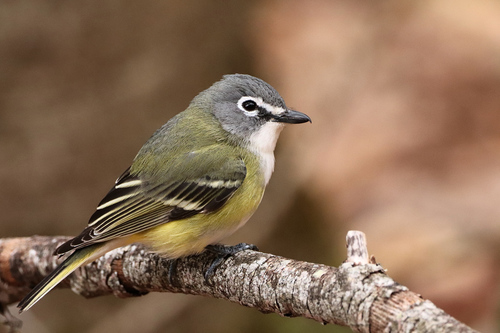
Blue-headed Vireo
Vireo solitarius
With its sophisticated slate-blue hood and crisp white spectacles, the Blue-headed Vireo is a standout of the forest canopy. Known for its calm demeanor and melodic, questioning song, this hardy migrant is a favorite find for patient backyard observers.
Quick Identification
Size
Length: 12-15 cm (4.7-5.9 in); Wingspan: 22-26 cm (8.7-10.2 in); Weight: 13-19 g (0.46-0.67 oz)
Colors
Slate-blue head with crisp white 'spectacles' around the eyes. Olive-green back and wings with two distinct white wing bars. White throat and belly with a subtle yellowish-green wash along the flanks.
Key Features
- Slate-blue head with bold white 'spectacles'
- Two prominent white wing bars
- Heavy, slightly hooked bill typical of vireos
- Yellowish wash on the flanks against white underparts
When You’ll See Them
Geographic range
Where Does the Blue-headed Vireo Live?
This resilient songbird is native to the vast forests of North America, breeding in a wide belt stretching across Canada and down through the northeastern United States and Appalachian Mountains. As a migratory species, it travels south to spend its winters in the southeastern United States, Mexico, and parts of Central America. You are most likely to encounter them in the deep, shaded woodlands of the north during the summer months or in coastal thickets during their journey south.
Basemap © OpenStreetMap contributors
Behavior
The Blue-headed Vireo is often described as a methodical and relatively 'tame' songbird. Unlike the frantic, high-energy movements of many warblers, this vireo moves through the canopy with deliberate, slow motions, carefully scanning the undersides of leaves for sluggish caterpillars and other insects. It is one of the first migratory birds to return to northern breeding grounds in the spring, often arriving while frost is still on the ground.
Socially, they are mostly solitary or found in pairs during the breeding season, though they frequently join mixed-species foraging flocks during migration and winter. A unique trait of this species is that the male often sings while sitting on the nest, a behavior that would be too risky for many other birds but seems to serve them well in the dense forest interior. While they aren't common backyard visitors in the traditional sense, they are surprisingly approachable for birdwatchers who spot them in the woods.
EverydayEarth exclusive
Camera Tips
Capturing the Blue-headed Vireo on camera requires a bit more strategy than your average backyard bird, as they spend much of their time high in the canopy. To bring them within range of an AI-powered camera, the best lure is a moving water feature. A birdbath with a dripper or a small recirculating waterfall is irresistible to them, especially during the dry days of migration. Position your camera about 3-5 feet from the water source, angled slightly downward to capture the bird as it lands on the edge to bathe or drink.
Because these birds are methodical foragers, they aren't attracted to standard seed feeders. However, if you have native fruiting shrubs like dogwood, serviceberry, or elderberry, mounting a camera nearby during the late summer and fall can be very productive. Set your camera to a fast shutter speed or high-frame-rate video mode, as while they move slowly while foraging, their splashes in a birdbath can be quite rapid. Use a 'motion-only' trigger setting to conserve battery life, as vireos are less frequent visitors than chickadees or titmice.
In terms of placement, look for edge habitats where a forest meets a clearing. If you can safely mount a camera 10-15 feet up a tree trunk overlooking a mid-story branch, you may capture their unique nesting behavior. Unlike many birds, the Blue-headed Vireo is relatively tolerant of human presence, so a camera placed discreetly near a known nesting site (usually in a fork of a branch) can provide incredible footage of both parents tending to the young.
Similar Species
Species that look similar or are commonly confused with Blue-headed Vireo.
Cassin's Vireo
Very similar but has a duller, more grayish-olive back and less contrast between the head and the body colors.
Plumbeous Vireo
Lacks the yellow wash on the flanks and the olive tones on the back, appearing entirely slate-gray and white.
White-eyed Vireo
Has distinct white eyes (irises) and yellow spectacles rather than white, and prefers low, scrubby thickets over high canopies.
Frequently Asked Questions
Record Blue-headed Vireo at your habitat
Connect a camera to start building your own species record — AI identifies every visitor automatically.