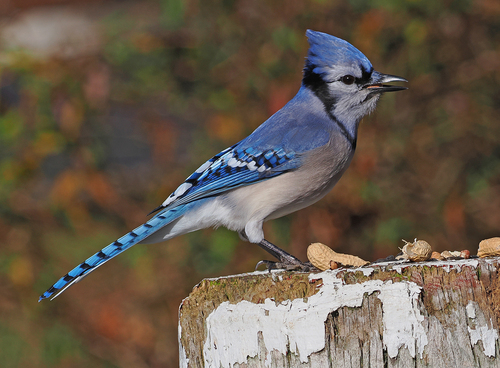
Blue Jay
Cyanocitta cristata
Bold, brilliant, and incredibly smart, the Blue Jay is the charismatic sentinel of the North American backyard. With its striking crest and complex social life, it's a favorite for birdwatchers and camera enthusiasts alike.
Quick Identification
Size
Length: 22-30 cm (9-12 in); Wingspan: 34-43 cm (13-17 in); Weight: 70-100 g (2.5-3.5 oz)
Colors
Vibrant blue upperparts, light gray to white underparts, a prominent blue crest, and a bold black 'necklace' or collar around the throat. Wings and tail feature white patches and black bars. Males and females look identical.
Key Features
- Prominent blue crest that can be raised or lowered based on mood
- Bold black U-shaped collar around the neck
- Complex wing patterns with white spots and black barring
- Strong, black bill used for cracking nuts and seeds
When You’ll See Them
Sightings on EverydayEarth
Jun 9, 2026
A very wet Blue Jay lands on the feeder tray. It pauses briefly, looking around with its feathers slicked down, before hopping off the edge of the tray.
Aug 1, 2026
The video captures a busy morning at the feeder. A Downy Woodpecker is seen clinging to the suet feeder on the left, while a White-throated Sparrow and a Common Grackle forage on the main seed tray. Around the seven-second mark, a Blue Jay swoops in and lands on the tray, causing the other birds to depart. The Blue Jay then begins to sift through the seeds.
Jul 30, 2026
A busy summer afternoon at the feeders features four different species feeding simultaneously. A Red-bellied Woodpecker works on a suet block on the left, while a Mourning Dove, a male Red-winged Blackbird, and a Blue Jay occupy the main feeder tray. The Blue Jay flies off early in the clip, but the other three remain to feed in the bright, dappled sunlight.
Jul 30, 2026
A Blue Jay is perched on the tray feeder before hopping onto the hanging tube feeder to forage. On the far left, a Downy Woodpecker is actively feeding on the suet-filled log feeder, moving vertically along the bark-like surface.
Jul 30, 2026
A busy mid-morning at the feeders sees several species arriving. A Common Grackle is seen briefly on the feeder tray before flying off. Shortly after, two Blue Jays arrive simultaneously; one lands on the main tray to forage through the seed while the other perches on the peanut cage to the right. Meanwhile, a smaller, streaked House Finch quietly feeds from the tube feeder in the background.
Jul 29, 2026
A high-activity scene unfolds during a rain shower. A Red-bellied Woodpecker feeds on a suet block to the left while a male Northern Cardinal perches just above it. In the center, a Blue Jay lands on the platform feeder to forage. On the right, a male Red-winged Blackbird feeds from a tube feeder, joined by another near the end of the clip.
Geographic range
Where Does the Blue Jay Live?
Native to North America, the Blue Jay occupies a massive territory spanning from southern Canada across the eastern and central United States. While they are permanent residents in much of their range, northern populations often migrate south along the Atlantic coast and Great Lakes. This adaptable bird is a staple of suburban backyards from the edge of the Rocky Mountains all the way to the Atlantic Ocean.
Basemap © OpenStreetMap contributors
Recorded on EverydayEarth
Behavior
Blue Jays are among the most intelligent and social birds found in North American backyards. They are members of the Corvidae family, making them relatives of crows and ravens, which is reflected in their complex social structures and problem-solving abilities. They are known for their loud, 'jay-jay' calls and their remarkable ability to mimic other birds, particularly Red-shouldered Hawks, which they often use to scare other birds away from feeders.
In the wild, Blue Jays act as forest sentinels, alerting all nearby animals to the presence of predators like owls or hawks. They are highly territorial during the nesting season but often travel in loose family groups during the winter. They are also famous 'planters' of trees; a single jay can cache thousands of acorns in a season, many of which are never recovered and eventually sprout into new oak trees.
EverydayEarth exclusive
Camera Tips
To capture the best footage of Blue Jays, your primary strategy should revolve around food—specifically peanuts. Blue Jays are obsessed with whole, in-shell peanuts. Place a flat platform feeder or a dedicated peanut wreath within 5 to 10 feet of your camera. Because Blue Jays are large and heavy compared to songbirds, they prefer stable, wide landing spots rather than hanging tube feeders. Set your camera at chest height (about 4-5 feet) and angle it slightly downward toward the feeder to capture the detail of their crest and wing bars.
Because Blue Jays are incredibly fast and often 'swoop' in, grab a nut, and leave immediately, you need a camera with a fast trigger speed (0.2 to 0.5 seconds). If your camera allows for 'Burst Mode' or 'Photo + Video,' enable it. The initial photo will capture the landing, while the video will catch their interesting behavior of 'weighing' different peanuts with their beaks to find the heaviest one before flying off.
Water is another fantastic lure. Blue Jays are frequent visitors to birdbaths and love to splash vigorously. Positioning your camera near a stone birdbath in the mid-afternoon will reward you with high-energy action shots. During the autumn, try placing your camera near the base of an oak tree; you might catch them 'caching' or burying acorns in the soil for the winter.
For lighting, try to position your camera with the sun at its back (facing north or south) to avoid silhouetting. The bright blue structural coloration of their feathers looks most stunning in direct morning light. If you are using a trail camera in a wooded area, look for clearings where sunlight hits the forest floor, as Blue Jays are much more active in these high-visibility zones than in deep, dark thickets.
Similar Species
Species that look similar or are commonly confused with Blue Jay.
Steller's Jay
Found in Western North America; has a much darker, charcoal-black head and crest compared to the Blue Jay's bright blue and white face.
Eastern Bluebird
Much smaller with a rounder body, no crest, and a distinctive orange-red breast instead of the Blue Jay's white underparts.
Florida Scrub-Jay
Lacks the crest and the white spotting on the wings; found only in specific scrub habitats in Florida.
Frequently Asked Questions
Record Blue Jay at your habitat
Connect a camera to start building your own species record — AI identifies every visitor automatically.