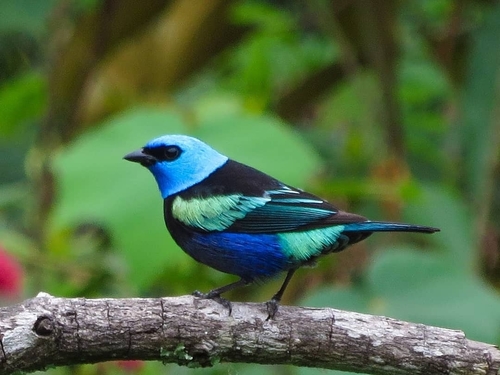
Blue-necked Tanager
Stilpnia cyanicollis
With its luminous turquoise head and striking golden wing patches, the Blue-necked Tanager is one of South America's most dazzling backyard visitors. This energetic songbird thrives in the lush canopy, bringing a splash of neon color to forest edges and tropical gardens alike.
Quick Identification
Size
Length of 12–13 cm (4.7–5.1 in); weight approximately 17 grams (0.6 oz).
Colors
Brilliant turquoise-blue head and neck; velvet black body; golden-yellow or straw-colored wing coverts; black mask through the eyes.
Key Features
- Luminous blue head and neck contrasting with black throat
- Golden-yellow wing patches visible in flight
- Black mask extending across the face
- Small, conical bill
- Average length of 13 cm
When You’ll See Them
Geographic range
Where Does the Blue-necked Tanager Live?
This stunning tanager is a native of South America, spanning a wide arc from the northern Andes to the Amazonian fringes. Its core range includes Colombia, Ecuador, Peru, and Bolivia, with significant populations also found in Venezuela and western Brazil. They are typically found in the humid tropical and subtropical zones, favoring areas where lush vegetation meets open clearings or agricultural edges.
Basemap © OpenStreetMap contributors
Behavior
Blue-necked Tanagers are highly social birds, often observed traveling in pairs or small family groups. They are a common fixture in mixed-species foraging flocks, frequently moving through the canopy alongside other tanagers, honeycreepers, and flowerpiercers. Their movement is energetic and restless, hopping quickly between branches as they search for food, often hanging upside down to reach berries on the ends of thin twigs.
While primarily forest dwellers, they are remarkably adaptable and have become increasingly comfortable in suburban gardens and shaded coffee plantations that provide adequate cover and fruit trees. They are generally peaceful but can be competitive at feeders, using their agile flight to claim prime spots. They are vocal birds, often letting out high-pitched, thin 'tsip' calls to maintain contact with their group while moving through dense foliage.
EverydayEarth exclusive
Camera Tips
Capturing the Blue-necked Tanager requires positioning your camera significantly higher than you would for ground-dwelling wildlife. These birds prefer the mid-to-upper canopy, so mounting your camera on a tree branch or a high-set bird station at 10 to 15 feet is ideal. Angle the lens slightly downward to capture the brilliant golden wing patches, which are most visible when the bird is perched or landing. Use a fast shutter speed or 'burst mode' setting, as these birds move with a nervous, rapid energy that can easily result in motion blur.
To attract them specifically to your backyard camera, nothing works better than fruit. Freshly sliced bananas, papayas, and oranges are irresistible to them. Place the fruit on a platform feeder or skewered to a branch within the camera’s focal range. Because they are shy around human activity but social with other birds, setting up the camera near a 'bubbler' or a shallow, elevated birdbath can also yield spectacular footage, as they frequently visit water sources to bathe and drink in the heat of the afternoon.
Optimal lighting is crucial for capturing their iridescent blue plumage. Try to position your camera so it faces away from the sun (north-facing is often best in their native range) to avoid silhouettes and to let the light hit the feathers directly, revealing the true saturation of the blue head. The 'sweet spot' for activity is usually early morning, just after sunrise, when they are most active in mixed flocks. If your camera has a 'capture lag' setting, set it to the minimum possible delay to ensure you don't miss them as they dart in for a quick bite and fly off again.
Similar Species
Species that look similar or are commonly confused with Blue-necked Tanager.
Frequently Asked Questions
Record Blue-necked Tanager at your habitat
Connect a camera to start building your own species record — AI identifies every visitor automatically.