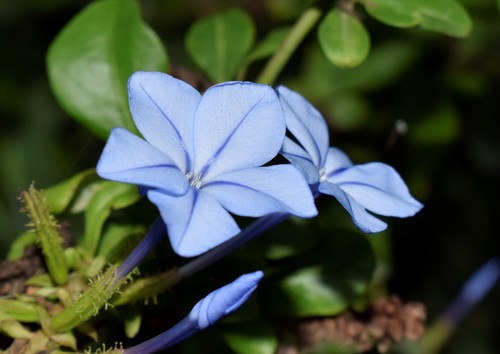
blue plumbago
Plumbago auriculata
A cascading explosion of sky-blue blooms, the Blue Plumbago is a hardy South African native that serves as a vital nectar station for butterflies. Whether sprawling over a fence or pruned into a formal hedge, its unique 'sticky' flowers and vibrant foliage bring life to any backyard habitat.
Quick Identification
Size
Height of 1.8–3 metres (6–10 feet) with a spread often reaching 2.4–3 metres (8–10 feet).
Colors
Sky-blue to pale violet five-petaled flowers; light, bright green foliage with a matte finish.
Key Features
- Phlox-like clusters of 5-petaled sky-blue flowers
- Sticky glandular hairs on the flower calyx (base)
- Spathulate (spoon-shaped) leaves with small ear-like lobes at the base
- Scrambling, arching woody stems.
When You’ll See Them
Geographic range
Where Does the blue plumbago Live?
Originally native to the southern regions of Africa, specifically South Africa and Mozambique, the Blue Plumbago has traveled far from its home continent. It is now a staple in Mediterranean climates and subtropical regions across the globe. You will find it flourishing throughout the southern United States—particularly in Florida, Texas, and California—as well as across Australia, southern Europe, and parts of Southeast Asia where it has often naturalized along roadsides.
Basemap © OpenStreetMap contributors
Behavior
Blue Plumbago is a vigorous, scrambling evergreen shrub that grows with a wild, arching habit. Unlike vines that use tendrils, it "scrambles" by leaning its long, thin branches against other plants or structures for support. It is highly valued for its prolific blooming season, often producing flowers year-round in tropical climates or from late spring through the first frost in more temperate zones.
A fascinating aspect of this plant's behavior is its method of seed dispersal. The calyx— the green tube at the base of the flower—is covered in tiny, sticky glandular hairs. These glands secrete a glue-like substance that causes the spent flowers and seed pods to hitchhike on passing animals or human clothing, a process known as epizoochory. This allows the plant to spread far beyond its original root site.
EverydayEarth exclusive
Camera Tips
Capturing the Blue Plumbago on camera is less about the plant itself and more about the diverse wildlife it attracts. To get the best shots, mount your AI-powered camera on a tripod or stake about 2 to 3 feet away from a cluster of fresh blooms. Position the lens at flower-height (typically 3 to 5 feet off the ground) to capture the side profile of visiting butterflies and bees. Because the petals are a light sky-blue, they can easily overexpose in harsh midday sun; try to angle your camera so it is slightly shaded or facing away from the direct sun to keep the blue tones rich and saturated.
This plant is the primary host for the Common Blue butterfly (Leptotes pirithous), so look for small, fluttering movements. If your camera has a macro or close-up setting, focus on the underside of the leaves or the base of the flowers where you might find caterpillars or the unique sticky calyx hairs. Setting your camera to a high-speed trigger or short video bursts will help you catch the fast-moving wings of the clearwing moths and long-tongued bees that frequent the nectar-rich tubes.
In larger backyards, Blue Plumbago is often used as a privacy screen. If you have a camera positioned for security or wide-angle wildlife viewing, use the Plumbago hedge as a 'natural blind.' Its dense, twiggy interior is a favorite hiding spot for small songbirds like wrens and sparrows. Placing a camera near the base of the shrub can reveal the secret lives of ground-dwelling birds and small mammals that use the arching branches as a protective canopy against aerial predators.
Similar Species
Species that look similar or are commonly confused with blue plumbago.
Frequently Asked Questions
Record blue plumbago at your habitat
Connect a camera to start building your own species record — AI identifies every visitor automatically.