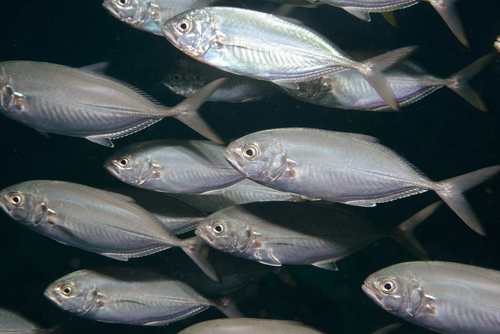
Blue Runner
Caranx crysos
A sleek, silver powerhouse of the Atlantic, the Blue Runner is a master of speed and schooling. Whether darting around a coastal pier or patrolling a coral reef, this energetic jack is a thrilling sight for any underwater observer.
Quick Identification
Size
Typically 30-35 cm (12-14 in), but can reach up to 70 cm (27.5 in); weight up to 5 kg (11 lbs)
Colors
Metallic bluish-green to olive-grey on the back, shading to silver or golden-yellow on the belly; distinct black spot on the operculum (gill cover)
Key Features
- Small black spot on the edge of the gill cover
- Elongated, fusiform body shape
- Strongly curved lateral line with 25-42 prominent scutes near the tail
- Deeply forked tail fin with a thin base
When You’ll See Them
Geographic range
Where Does the Blue Runner Live?
The Blue Runner is a wide-ranging marine traveler native to the Atlantic Ocean. In the Western Atlantic, its territory stretches from the cool waters of Nova Scotia, Canada, through the Gulf of Mexico, and down the coast of South America to the shores of Brazil. Across the ocean in the Eastern Atlantic, these fish are commonly found from Great Britain and the Mediterranean Sea all the way south to the coast of Angola, making them one of the most widely distributed jacks in the world.
Basemap © OpenStreetMap contributors
Behavior
Blue Runners are high-energy, schooling fish known for their incredible speed and social nature. They are often found in large groups, sometimes numbering in the hundreds, patrolling coastal waters and reefs. These schools act as a cohesive unit to confuse predators and more effectively corral schools of smaller baitfish. While they are nomadic by nature, they have a strong affinity for structures, often congregating around piers, rock jetties, and offshore oil platforms.
In terms of interaction with humans, they are a frequent sight for snorkelers and divers near reefs. Because they are curious and aggressive feeders, they often approach underwater cameras or divers to investigate. While they are edible, they are most highly valued by anglers as a hard-fighting game fish or as live bait for larger pelagic predators like Marlin or Sailfish.
EverydayEarth exclusive
Camera Tips
Capturing the Blue Runner requires an underwater camera setup, ideally positioned near a structure like a dock piling or a reef edge. Because these fish are extremely fast, use a camera with a high frame rate (at least 60fps) to avoid motion blur. Position your camera at a depth of 2 to 5 meters where sunlight still penetrates clearly, as the metallic sheen of their scales looks best in natural light.
To attract a school to your lens, use a mesh chum bag filled with ground fish or shrimp secured within the camera's field of view. Blue Runners are highly visual hunters and are often attracted to shiny, moving objects. You can hang a small, reflective piece of metal or a 'flash' spoon near the camera to pique their curiosity and keep the school circling the area for longer periods.
For the best results, set your camera to trigger on fast motion. Since they often travel in tight schools, a single trigger can result in spectacular footage of dozens of fish passing the lens simultaneously. If you are filming near a pier, try to angle the camera slightly upward toward the surface to capture the silver flash of their bellies against the sun, which provides a dramatic, high-contrast silhouette.
Similar Species
Species that look similar or are commonly confused with Blue Runner.
Frequently Asked Questions
Record Blue Runner at your habitat
Connect a camera to start building your own species record — AI identifies every visitor automatically.