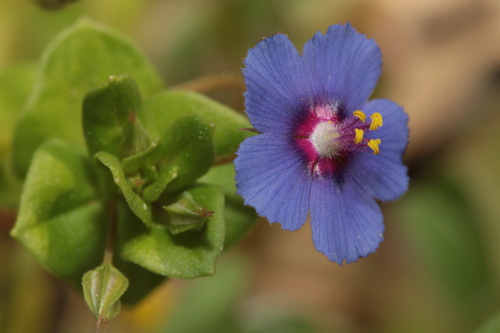
Blue Scarlet Pimpernel
Lysimachia loeflingii
A natural barometer of the Mediterranean, the Blue Scarlet Pimpernel blankets the earth in brilliant azure blooms that only open for the sun.
Quick Identification
Size
Height 5–15 cm (2–6 in); flower diameter 10–15 mm (0.4–0.6 in)
Colors
Brilliant azure-blue petals with a contrasting magenta or reddish-purple center; bright yellow anthers; light green foliage
Key Features
- Five-petaled brilliant blue flowers
- Deep red or purple 'eye' at the base of the petals
- Low-growing, trailing stems that sprawl across the ground
- Opposite, oval-shaped leaves without stalks (sessile)
- Flowers close tightly during cloudy weather or at night
When You’ll See Them
Geographic range
Where Does the Blue Scarlet Pimpernel Live?
The Blue Scarlet Pimpernel is primarily native to the Mediterranean region of Southern Europe and North Africa. Its core range is centered on the Iberian Peninsula, with significant populations found throughout Portugal and Spain. It also extends across the Mediterranean coast into countries like Morocco and Tunisia, thriving in sun-drenched, sandy environments where competition from taller grasses is minimal.
Basemap © OpenStreetMap contributors
Behavior
The Blue Scarlet Pimpernel is a sun-loving annual wildflower known for its remarkable sensitivity to light and humidity. This species exhibits nictinasty, a behavior where the flowers open fully only in direct sunlight and close tightly in response to shade, rain, or approaching darkness. This reactive nature has earned its close relatives the traditional name 'Poor Man's Weatherglass,' as the closing petals often signal an incoming storm.
As a low-growing plant, it does not compete for height but instead spreads horizontally, forming small patches of intense color in open ground. It is an opportunistic grower, often appearing in the wake of soil disturbance. It provides a vital nectar source for small, specialized pollinators like hoverflies and solitary bees that are active in the heat of the day.
EverydayEarth exclusive
Camera Tips
Capturing the Blue Scarlet Pimpernel requires a different strategy than photographing mobile wildlife. Because the plant sits just inches off the ground, you must position your camera at a very low angle. Use a ground-level tripod or a beanbag to stabilize your camera just 2–5 inches above the soil. Tilting the lens slightly upward can help highlight the intricate 'eye' of the flower and the yellow anthers against the blue petals.
Since this species is known as the 'weatherglass,' it makes an excellent subject for time-lapse photography. Set your camera to capture an image every 2 minutes starting an hour before sunrise and continuing until late afternoon. This will create a stunning sequence showing the flowers unfurling as the sun hits them and closing as the light fades or clouds pass over. Ensure your camera is in a spot that receives full, unobstructed sunlight for the best results.
To capture the insects that visit the Blue Scarlet Pimpernel, use a high shutter speed (at least 1/1000s) or a high-frame-rate video setting. Focus on a particularly vibrant cluster of blooms and wait for the sun to be at its peak, which is when pollinators are most active. Because the flowers are small, a macro lens or a close-up filter is essential to get the detail needed for a professional-looking shot. Avoid using a flash if possible, as the natural sunlight better brings out the true 'electric' blue of the petals.
Similar Species
Species that look similar or are commonly confused with Blue Scarlet Pimpernel.
Frequently Asked Questions
Record Blue Scarlet Pimpernel at your habitat
Connect a camera to start building your own species record — AI identifies every visitor automatically.