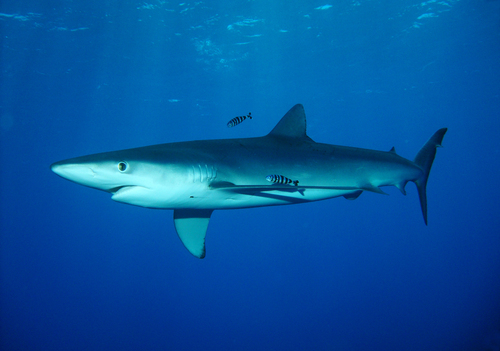
Blue Shark
Prionace glauca
Meet the most widely traveled wanderer of the deep blue, known for its stunning indigo skin and incredible transoceanic journeys.
Quick Identification
Size
6 to 11 feet (1.8 to 3.3 meters); 60 to 450 lbs (27 to 205 kg)
Colors
Metallic indigo back, bright sapphire blue sides, and a stark white underside
Key Features
- Extraordinarily long, wing-like pectoral fins
- Vivid indigo-blue coloration on the upper body
- Slender, hydrodynamic 'torpedo' silhouette
- Large, dark eyes and a long, pointed snout
When You’ll See Them
Geographic range
Where Does the Blue Shark Live?
Blue sharks are among the most widely distributed animals on Earth, native to every ocean except the Arctic. They are most commonly found in temperate and tropical waters from the coastlines of North America and Europe down to South Africa, Australia, and South America. These incredible voyagers are famous for their transoceanic migrations, frequently crossing the entire Atlantic or Pacific to find better feeding grounds or mating opportunities.
Basemap © OpenStreetMap contributors
Behavior
The Blue Shark is a highly migratory pelagic predator, renowned for its incredible stamina and sleek, efficient swimming style. Unlike many other large sharks, they are often social and have been observed traveling in sex-segregated groups or 'schools.' They are known as the 'wolves of the sea' due to their habit of shadowing schools of prey for long distances. While they spend much of their time in the deep, cool waters of the open ocean, they frequently migrate toward the surface at night to feed.
In terms of interaction with humans, Blue Sharks are famously inquisitive. Divers often find them approaching closely to investigate equipment or movement. While they are not considered as aggressive as Bull or Tiger sharks, they are large predators that must be treated with respect. They are extremely sensitive to electromagnetic fields, using specialized pores in their snouts called the Ampullae of Lorenzini to detect the heartbeat or muscle contractions of prey in the darkness.
EverydayEarth exclusive
Camera Tips
Capturing a Blue Shark on camera requires moving away from the typical trail cam setup and into the world of Baited Remote Underwater Video (BRUV). To get high-quality footage, you will need a waterproof housing rated for at least 10 meters if you are filming from a pier or boat, or much deeper for offshore rigs. Mounting your camera to a weighted frame or a tethered buoy is the most effective way to keep the shot stable in moving ocean currents. Use a wide-angle lens, as these sharks like to get very close to the lens to investigate the electronics.
Because Blue Sharks rely heavily on their sense of smell, 'baiting' the camera is essential for a successful capture. A mesh scent bag filled with oily fish like sardines or mackerel (known as chum) should be secured approximately 1 to 2 meters in front of the lens. This creates a scent trail that draws sharks from kilometers away. Ensure the bait is secured well so the shark doesn't swim off with your entire rig!
Timing and lighting are your biggest challenges. While Blue Sharks are active during the day, their activity increases at night. If you are filming after dark, you must use high-intensity underwater LED lights with a high CRI (Color Rendering Index) to capture the shark's stunning sapphire blue color. Without artificial light, the shark will appear grey or black at depth. In many regions, the best time to see them is during the summer months when they follow warm-water currents closer to the continental shelf.
Similar Species
Species that look similar or are commonly confused with Blue Shark.
Frequently Asked Questions
Record Blue Shark at your habitat
Connect a camera to start building your own species record — AI identifies every visitor automatically.