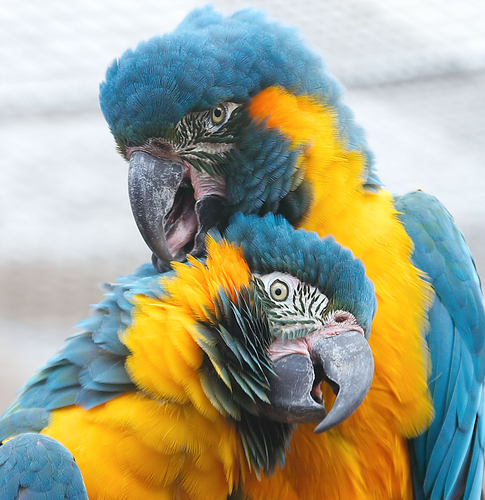
Blue-throated Macaw
Ara glaucogularis
Bolivia's rarest flying treasure, the Blue-throated Macaw is a vibrant masterpiece of turquoise and gold. Once thought to be extinct in the wild, this elusive bird now finds sanctuary in the remote palm groves of the Beni savannas.
Quick Identification
Size
Length of 85 cm (33 in); wingspan approximately 90-100 cm (35-39 in); weight 600-800 g (1.3-1.8 lbs)
Colors
Turquoise-blue upperparts, bright yellow to golden-orange underparts, and a distinctive blue throat patch
Key Features
- Distinctive turquoise-blue throat patch extending to the ear-coverts
- Bare white facial skin with fine lines of blue feathers
- Long, elegant blue tail with yellowish undersides
- Smaller and more slender build than the Blue-and-yellow Macaw
When You’ll See Them
Geographic range
Where Does the Blue-throated Macaw Live?
Native to the heart of South America, the Blue-throated Macaw is found exclusively within a very restricted region of north-central Bolivia. Its entire wild population is confined to the tropical savannas of the Beni Department, specifically the Llanos de Moxos. Unlike many other parrots, there are no established introduced populations elsewhere in the world, making this one of the most geographically localized bird species on the planet.
Basemap © OpenStreetMap contributors
Behavior
The Blue-throated Macaw is a highly social and intelligent bird, though it is notably more shy and elusive than its more common relatives. They are typically found in monogamous pairs that remain together for life, often seen flying close to one another or grooming each other in the canopy. While they do congregate in small family groups, large flocks are rare due to their critically low population numbers.
These macaws are diurnal and spend a significant portion of their day foraging and resting within palm groves. Their communication consists of high-pitched squawks and calls that are distinct from other macaws, often sounding more nasal. In the wild, they are wary of human presence, a trait likely reinforced by historical hunting pressure, though they are known to be inquisitive when they feel secure.
EverydayEarth exclusive
Camera Tips
Capturing the Blue-throated Macaw on camera requires patience and specialized placement, as these birds spend the majority of their time high in the canopy. To get the best results, position your camera at an elevated vantage point overlooking Motacú palm stands. These trees are their primary food source and nesting sites; a camera angled slightly downward from a neighboring tree or a high platform can capture intimate feeding behaviors that ground-level shots would miss.
Because they are most active during the early morning and late afternoon, ensure your camera's exposure settings are optimized for the golden hour. A fast shutter speed is essential if you hope to catch them in flight, as their wingbeats are rapid. Given their status as a critically endangered species, it is vital to use non-intrusive equipment. Avoid using bright white flashes at night near known nesting hollows, as this can cause them to abandon their chicks; instead, rely on high-quality infrared sensors for low-light activity.
Baiting is generally discouraged for this sensitive species to avoid habituation or dietary issues. Instead, focus on 'natural' lures by placing cameras near shallow water pools in the savanna during the dry season, where they may descend to drink. If you are using a trail camera, set it to 'Burst Mode' or 'Photo + Video' to capture the complex social interactions between pairs, which often involve subtle head-bobbing and beak-touching.
Similar Species
Species that look similar or are commonly confused with Blue-throated Macaw.
Frequently Asked Questions
Record Blue-throated Macaw at your habitat
Connect a camera to start building your own species record — AI identifies every visitor automatically.