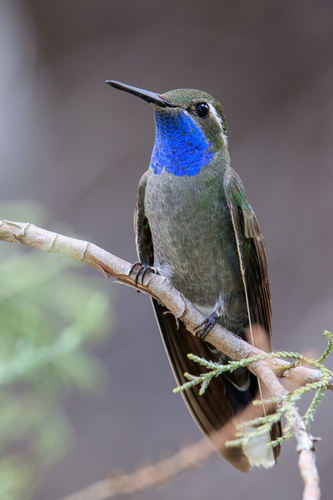
Blue-throated Mountain-gem
Lampornis clemenciae
The heavy-weight champion of the Southwest's hummingbird world, the Blue-throated Mountain-gem is as bold in personality as it is brilliant in color.
Quick Identification
Size
Length: 11-13 cm (4.3-5.1 in); Wingspan: 16-18 cm (6.3-7 in); Weight: 6-10 g (0.21-0.35 oz)
Colors
Metallic bronze-green upperparts, dull greyish underparts. Males possess a brilliant iridescent blue throat (gorget). Both sexes feature a bold white stripe behind the eye and a blackish cheek.
Key Features
- Large size, significantly bigger than common backyard hummingbirds
- Iridescent blue throat patch on males
- Broad black tail with large white corner tips
- Distinctive white post-ocular stripe
When You’ll See Them
Geographic range
Where Does the Blue-throated Mountain-gem Live?
Native to the mountain ranges of North America, the Blue-throated Mountain-gem primarily inhabits the cool, moist canyons of the Mexican highlands. Its northern range extends into the 'Sky Islands' of the Southwestern United States, specifically in Arizona, New Mexico, and West Texas. While some populations in central Mexico are year-round residents, those at the northern edge of the range are migratory, arriving in late spring to breed in high-altitude environments.
Basemap © OpenStreetMap contributors
Behavior
The Blue-throated Mountain-gem is a remarkably assertive and vocal hummingbird. Unlike many of its smaller relatives, it produces a loud, piercing 'seep' call that is often the first sign of its presence in a canyon. Males are highly territorial, frequently claiming a specific feeder or a patch of flowers and aggressively chasing away intruders, including much larger birds. Despite this bravado, they are known to be quite curious about humans and may hover just a few feet away from observers to investigate.
During the breeding season, females exhibit unique nesting behavior, often building their nests on hanging wires, under the eaves of cabins, or on branches overhanging mountain streams. They are 'site-faithful,' meaning they often return to the exact same nesting spot year after year, sometimes building new nests directly on top of the old ones. Their flight is more direct and slightly slower-looking than smaller hummingbirds, owing to their larger body mass and significant wingspan.
EverydayEarth exclusive
Camera Tips
To capture high-quality images of the Blue-throated Mountain-gem, place your AI-powered camera near high-nectar sources or red tubular flowers like Penstemon. Because these birds are large and relatively bold, they are less easily spooked by equipment than smaller species. Aim the lens at a 45-degree angle to a hummingbird feeder, approximately 3 to 5 feet away, ensuring the background is naturally cluttered with greenery to provide depth.
Lighting is critical for capturing the namesake blue throat. Position the camera so the sun is behind you or at a slight side angle. Iridescence requires light to bounce off the feathers toward the lens; direct overhead midday sun often makes the throat look black. Early morning or late afternoon light provides the best results for illuminating the metallic blue gorget and the subtle bronze tones of the back.
Technical settings should prioritize speed. If your camera allows for custom triggers, set the sensitivity high. These birds move fast, but their large size makes them easier for AI models to detect than smaller hummingbirds. Use a high frame rate for video or a 'burst' photo mode to ensure you catch the wings in a favorable position. A background of dark green foliage will make the white-tipped tail feathers pop in the frame.
Beyond standard 4:1 nectar feeders, planting native species will encourage these birds to linger. They are highly territorial, so if you have one visiting, it will likely return to the same branch or perch repeatedly—focus your camera on these 'guarding' perches for the most artistic shots. They also frequently visit water features, so a camera aimed at a misting station or a shallow, moving birdbath can capture unique bathing behavior.
Similar Species
Species that look similar or are commonly confused with Blue-throated Mountain-gem.
Frequently Asked Questions
Record Blue-throated Mountain-gem at your habitat
Connect a camera to start building your own species record — AI identifies every visitor automatically.