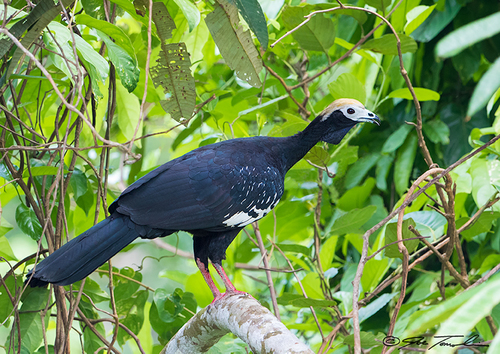
Blue-throated Piping-Guan
Pipile cumanensis
A striking inhabitant of the Amazonian canopy, the Blue-throated Piping-Guan is instantly recognizable by its brilliant blue wattle and elegant white crest. This 'forest turkey' plays a vital role in its ecosystem by dispersing seeds across the tropical lowlands.
Quick Identification
Size
Length: 60-70 cm (24-28 in); Weight: 1.1-1.3 kg (2.4-2.9 lbs)
Colors
Mainly black plumage with a blue or green metallic sheen; prominent white wing patches; white-feathered crest; bright cobalt-blue throat wattle.
Key Features
- Bright cobalt-blue fleshy wattle on the throat
- Large white patches on the wings visible when perched
- White crest with fine black streaks
- Long, broad tail and turkey-like silhouette
When You’ll See Them
Geographic range
Where Does the Blue-throated Piping-Guan Live?
Native to the heart of South America, the Blue-throated Piping-Guan is a resident of the vast Amazon Basin and its surrounding tropical lowlands. Its core range stretches across Brazil, Peru, and Bolivia, reaching northward into Colombia, Ecuador, Venezuela, and the Guianas. This species is almost always found in close proximity to water, favoring the lush, dense vegetation that lines major river systems and seasonally flooded forests.
Basemap © OpenStreetMap contributors
Behavior
The Blue-throated Piping-Guan is a highly arboreal species, spending the vast majority of its life in the middle and upper layers of the forest canopy. They are most famous for their dawn displays, where males perform a 'wing-drumming' flight, leaping between branches and creating a distinctive rattling sound with their primary feathers to mark their territory.
Socially, these birds are typically found in pairs or small family groups. They are agile movers in the treetops, often seen running along thick branches or hopping with surprising grace rather than flying long distances. While they are naturally wary in areas where hunting occurs, they can become quite accustomed to human presence in protected rainforest lodges, often visiting fruiting trees near buildings.
EverydayEarth exclusive
Camera Tips
To successfully capture the Blue-throated Piping-Guan on a trail camera, focus on 'high-traffic' arboreal corridors. If you have access to a canopy walkway or a steep slope that looks into the mid-story of the forest, mount your camera at head-height relative to the branches. These birds love horizontal 'highways' in the trees. Angle your camera slightly downward to catch them as they forage for fallen fruit on lower limbs.
Ground placement can also be effective if located near a forest 'salt lick' or a secluded riverbank where the birds come down to drink. Use a fast trigger speed—these birds can be surprisingly quick when they hop. Because they are most active in the dim light of dawn, ensure your camera has a high-quality CMOS sensor that handles low-light conditions without excessive grain.
If you are in a backyard setting near a forest edge, planting native fruiting palms is the best long-term attractant. Set your camera to video mode (20-30 seconds) rather than still photos; the vocalizations and the 'piping' whistles of this species are just as interesting as their appearance and can help confirm identification if the bird is partially obscured by foliage.
Similar Species
Species that look similar or are commonly confused with Blue-throated Piping-Guan.
Red-throated Piping-Guan
Features a bright red throat wattle instead of blue, and is typically found in different geographic regions like the Atlantic Forest.
Trinidad Piping-Guan
Critically endangered and endemic only to the island of Trinidad; it has a smaller blue wattle and more extensive white on the wings.
Frequently Asked Questions
Record Blue-throated Piping-Guan at your habitat
Connect a camera to start building your own species record — AI identifies every visitor automatically.