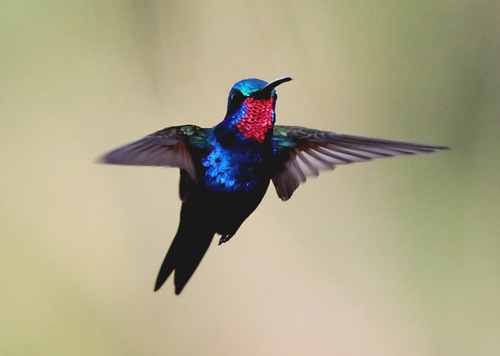
Blue-tufted Starthroat
Heliomaster furcifer
With its shimmering violet throat and extraordinary blue neck tufts, the Blue-tufted Starthroat is one of South America's most dazzling hummingbirds. This long-billed beauty is a master of the open savanna, bringing a flash of iridescent color to backyards from Brazil to Argentina.
Quick Identification
Size
12.5–13 cm (4.9–5.1 in) in length; weight approximately 6.5 g (0.23 oz)
Colors
Male features metallic green upperparts, a glittering violet-purple throat, and bright blue tufts on the sides of the neck. Females are bronzy-green above with grayish-white underparts and dark speckling on the throat.
Key Features
- Long, slightly decurved black bill
- Iridescent violet-purple gorget (males)
- Flares of brilliant blue feathers on neck sides
- White streak behind the eye and white patch on the rump
When You’ll See Them
Geographic range
Where Does the Blue-tufted Starthroat Live?
This striking hummingbird is native to the heart of South America, spanning a vast area from the southern Amazon basin down through central Argentina. It is most commonly found throughout the Cerrado of Brazil, the Chaco regions of Paraguay and eastern Bolivia, and into the temperate grasslands of Uruguay. While it is a staple of these central regions, its nomadic tendencies lead to occasional sightings as far north as Colombia and Peru, following the seasonal blooms of its favorite trees.
Basemap © OpenStreetMap contributors
Behavior
The Blue-tufted Starthroat is an energetic and somewhat bold hummingbird known for its preference for open spaces. Unlike many forest-dwelling hummingbirds, this species spends much of its time on high, exposed perches, such as the tips of dead branches. From these vantage points, it surveys its territory and watches for both nectar sources and passing insects. It is a solitary bird, often seen defending a specific patch of flowering trees from competitors.
Its flight is powerful and direct, and it is particularly well-known for its 'hawking' behavior. While nectar is its primary fuel, the starthroat is a skilled aerial hunter, darting out from its perch to snatch small flies and gnats mid-air. This high-protein diet is especially vital during the breeding season. In suburban environments, they are frequent visitors to gardens, though they remain wary and quick to take flight if disturbed.
EverydayEarth exclusive
Camera Tips
To capture the Blue-tufted Starthroat on an AI-powered camera, placement is everything. These birds have a habit of using 'sentinel perches'—exposed, high-up twigs that give them a clear view of their surroundings. Instead of just pointing your camera at a feeder, try mounting it 5 to 8 feet high, aimed at a bare branch near a flowering tree. This is where you will catch the bird in its most majestic, still poses, rather than just a blur at a feeder.
Lighting is the 'secret sauce' for photographing this species. The male's iridescent blue neck tufts and violet throat are directional; they only glow when the light hits them from the front. Position your camera so it faces north (if you are in the Southern Hemisphere), ensuring the sun is behind the camera during the morning and late afternoon. This 'golden hour' light will illuminate the structural colors of the feathers, turning a dark-looking bird into a shimmering jewel.
Because starthroats are larger and slightly more deliberate in their hovering than smaller woodstars, you can use a slightly lower trigger sensitivity to avoid 'false positives' from moving leaves, but keep the shutter speed high. If your camera settings allow, set a shutter speed of at least 1/2000s to freeze the wing motion. If you are using a backyard feeder to attract them, place the camera 18 to 24 inches away to ensure the bird fills the frame without being so close that the focus struggles with their rapid movements.
Similar Species
Species that look similar or are commonly confused with Blue-tufted Starthroat.
Frequently Asked Questions
Record Blue-tufted Starthroat at your habitat
Connect a camera to start building your own species record — AI identifies every visitor automatically.