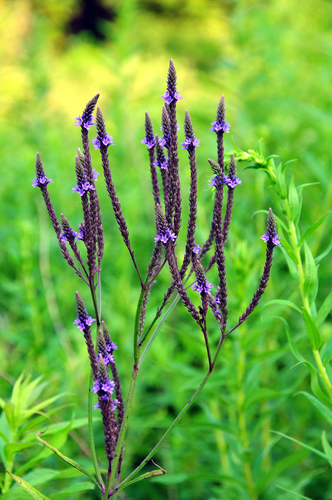
blue vervain
Verbena hastata
An architectural marvel of the wet meadow, Blue vervain stands tall with its distinctive candelabra of violet blooms, serving as a vital sanctuary for North American pollinators.
Quick Identification
Size
Height of 2–5 feet (0.6–1.5 meters) with a spread of 1–2 feet (30–60 centimeters)
Colors
Deep violet-blue or purplish flowers; dark green foliage; square stems often tinged with reddish-purple
Key Features
- Distinctive candelabra-like branching flower spikes
- Small, five-lobed tubular flowers that bloom in rings moving upward
- Opposite, lance-shaped leaves with sharply serrated edges
- Hairy, square-shaped stems typical of the vervain family
When You’ll See Them
Geographic range
Where Does the blue vervain Live?
Native to the North American continent, Blue vervain is a widespread inhabitant found across nearly every state in the continental United States and throughout the southern provinces of Canada. This resilient wildflower thrives from the Atlantic coast to the Pacific Northwest, favoring regions where the soil remains consistently moist, such as the Great Lakes basin and the Mississippi River valley. It is a staple of temperate North American wetlands and damp lowlands.
Basemap © OpenStreetMap contributors
Behavior
Blue vervain is a robust perennial that serves as a high-traffic hub for backyard biodiversity. Unlike animals, its 'behavior' is defined by its blooming cycle; the plant produces numerous pencil-thin spikes where tiny flowers open a few at a time, creating a slow-motion firework effect that lasts from mid-summer into early autumn. This staggered blooming strategy ensures a reliable, long-term food source for local insects.
In a garden or wild setting, it is a social plant, often found growing in clumps or small colonies. It interacts deeply with the local fauna, acting as a larval host for the Common Buckeye butterfly and providing essential late-season nectar. As the flowers turn to seed, the plant remains upright, offering a sturdy perch and winter sustenance for small foraging birds.
EverydayEarth exclusive
Camera Tips
Capturing the activity on Blue vervain requires focusing on the insect and bird life it attracts rather than the plant itself. Position your camera approximately 3 to 4 feet off the ground, angled slightly downward to frame the top of the flower 'candelabras.' Because this species thrives in wet soil, use a stabilized mount or a weighted tripod to prevent the camera from leaning if the ground is soft.
For high-quality results, use a camera with a close-focus or macro capability. Setting the camera to 'Time-Lapse' mode during the morning hours (7 AM to 11 AM) is a fantastic way to document the variety of native bees and butterflies that visit. If your camera supports high-speed triggers, use them to catch the rapid movement of the Silver-spotted Skipper or various bumblebee species that frequent the blooms.
Don't stop filming once the flowers fade in autumn. The seed heads are a magnet for American Goldfinches and Cardinals. During the late fall, lower your camera to about 2 feet off the ground to capture these birds as they cling to the stalks to forage. Position the camera so the sun is behind it to illuminate the vibrant blue of the flowers or the texture of the winter seed heads.
Similar Species
Species that look similar or are commonly confused with blue vervain.
Hoary Vervain
Prefers dry soil and has fuzzy, grey-green leaves without stalks, unlike the smooth, petioled leaves of Blue vervain.
Purple Loosestrife
An invasive species with much larger, showier flower spikes that lack the branching 'candelabra' shape of Blue vervain.
Swamp Milkweed
Shares the same wet habitat but features clusters of pink, hooded flowers and milky sap, quite different from the tiny blue tubes of vervain.
Frequently Asked Questions
Record blue vervain at your habitat
Connect a camera to start building your own species record — AI identifies every visitor automatically.